
In short: Plan a destination wedding in Europe in this order: country, season and guest count first, 12 months or more ahead. Then the venue and date, then photographer and videographer, then everyone else. Book flights and send invitations about 6 months ahead, sort documents and the day’s schedule at 3 to 4 months, and arrive at least 3 days early. An elopement for two can be planned in 8 to 12 weeks.
Who this timeline is for
Couples who plan from another country, often the US, UK, Canada or Australia, for 20 to 120 guests. Each decision locks the next one. The venue fixes the date. The date decides which photographers and musicians are free. The guest count decides the venue. So the order matters more than the speed.
With 18 months you follow the same steps and get first pick. With 6 months it still works if you choose a weekday or a quieter month and let a planner do the local legwork. All our planning guides are collected in the planning hub.
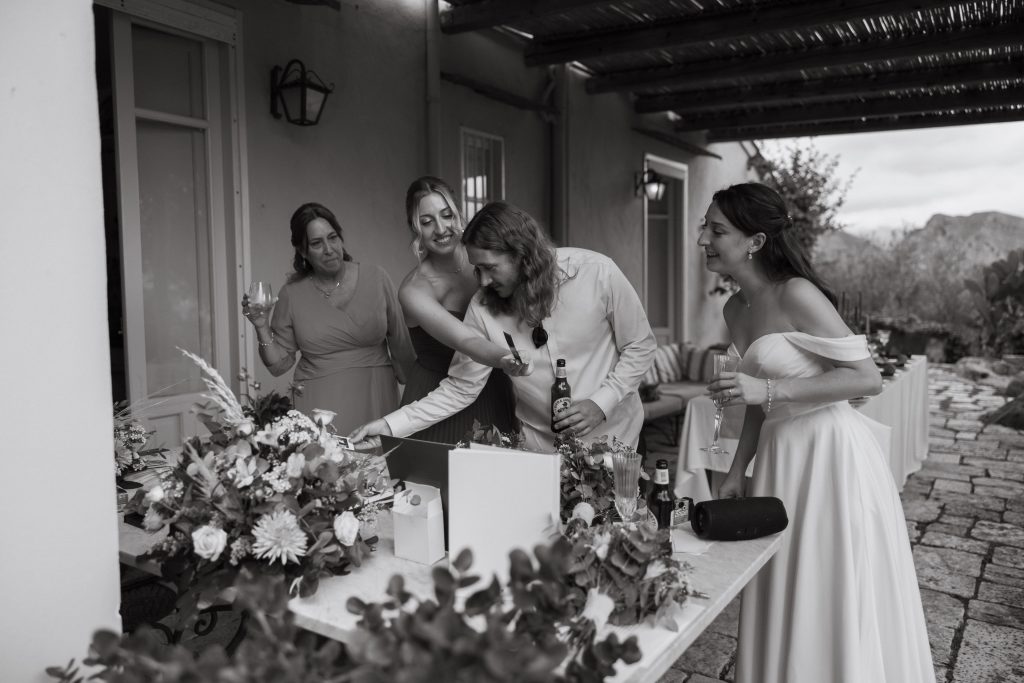 Nik & Ashley · Sicily · see the full wedding →
The 12-month checklist, period by period
12 months or more: the big decisions
- Country and season. Choose the month before the exact place. In southern Europe, May, June, September and early October are kinder than July and August, which are hot and crowded. In the Nordics the main season is June to August.
- Legal or symbolic. Decide whether to marry legally in Europe, or sign the papers at home and hold a symbolic ceremony abroad. The rules differ in every country. Start with our ceremony and legal guides.
- Guest count. A realistic number, not a hopeful one. It decides the size of the venue and how many rooms you need nearby.
- Budget split. Fix one total in euros and name your top three priorities. Venue and food take the largest share at most weddings. Spend the rest on what you will still have in ten years.
- Planner. If you cannot visit before the wedding, a local planner is your eyes, your translator and your plan B. Book the wedding planner first, because the planner shortlists venues.
10 to 12 months: venue, date, photo and film
- Venue and date. Ask every venue the same questions: exclusive use, music curfew, an indoor space for rain, rooms on site, access for older guests, and where the sun is at ceremony time.
- Photographer and videographer. Book them as soon as the date is fixed. A team can be in one place per day, and the best dates go first. Our prices are on the investment page.
- Save-the-dates. Include the town, the nearest airport and the dates of the whole stay, so guests can ask for time off.
- Room blocks. Hold rooms in one or two hotels near the venue and note the date when unsold rooms are released.
8 to 10 months: the people who shape the day
- Catering, if the venue does not provide it. Ask caterers about tastings, dietary needs and how late the kitchen can serve.
- Music. One plan for ceremony, drinks and party. Ask bands and DJs about sound limits at your venue.
- Hair and makeup. Book an artist who comes to you, and agree on a trial date.
- Officiant. For a symbolic ceremony, a celebrant or a friend. For a legal one, the registrar or priest often sets the hour, so ask early.
- Legal paperwork research. Ask the registry office or town hall where you will marry for its document list in writing. Ask whether papers need an apostille (the certificate that makes a public document valid abroad), sworn translations, and how recent they must be.
6 months: travel and backup
- Flights. Book yours, and send guests the nearest airports and transfer times.
- Invitations. Set the reply date 8 to 10 weeks before the wedding.
- Transport. Shuttles between hotels and venue, boat and ferry times, the last ferry back. Taxis are scarce in small towns and on islands.
- Plan B for weather. Choose a covered space you actually like, and agree on the hour when you decide on the day.
- Passports. Check every expiry date now. The rules are below.
3 to 4 months: documents, schedule, trials
- Documents. For a legal ceremony, order certificates, apostilles and translations now. Many offices accept only recently issued papers, so check the limit before you order.
- Timeline draft built around the light. Look up the sunset for your date and place. In summer, set the ceremony 2.5 to 3 hours before it and keep 20 to 30 minutes for portraits in the last hour of sun. Our photo location guides help you choose where.
- Trials. Hair and makeup, and the menu tasting. If you cannot fly over, do the hair trial in wedding week.
- Outfits and rings. Finish alterations. Plan to carry the dress and the rings in hand luggage.
- Welcome dinner and day-after plans. Reserve them.
1 month: final numbers
- Final numbers. Guest count, table plan and dietary list go to the venue and caterer.
- Payments. Check each contract for the due date. Send international transfers a week early.
- Shot list of family groups only. Write 8 to 10 groups with first names and give the list to one loud, organised relative. Leave everything else to the photographer.
- Final timeline. Send it to every vendor with addresses and phone numbers.
Wedding week
- Arrive at least 3 days early. Jet lag, a delayed suitcase and a rainy day all need room.
- Walk the venue at ceremony time. You will see where the sun and the shade fall, and where guests will squint.
- Welcome dinner. The evening before, and finished early.
- Hand over. Rings, vows, documents and tip envelopes go to one trusted person. Then stop planning.
book in the order that removes the most uncertainty. Venue and date first, then the people who can only be in one place per day, then everything that can be ordered in any quantity.
The short version: an elopement in 8 to 12 weeks
For two people, or for you and a handful of guests, the list shrinks. See our elopement guides for places and legal notes by country.
| Weeks before | What to do |
|---|---|
| 12 to 10 | Choose the place and a weekday date. Decide legal or symbolic. Book photographer, filmmaker and a place to stay. |
| 10 to 8 | Book flights. Book a celebrant if you want one. Start any legal paperwork at once, or plan to sign at home. |
| 6 | Outfits, rings, flowers, hair and makeup, a dinner reservation. |
| 4 | Build the timeline around sunrise or sunset. Pick a second spot for rain or wind. Ask whether the location needs a permit. |
| 1 | Check the forecast, confirm times, write your vows. |
A legal ceremony on this schedule is realistic in only some countries, so read the rules for your exact country before you book flights. A symbolic ceremony has no paperwork and can happen wherever you are allowed to stand.
Passports and entry rules for US couples
This is the position as of November 2026. Check the official pages again before you book flights and a month before you travel, because start dates and fees change. The same rules apply to visitors from the UK, Canada and Australia.
- The 90/180 rule. US citizens can visit without a visa for up to 90 days in any 180-day period. The days are counted as one total across the 29 countries that use the Entry/Exit System, including Italy, Spain, France, Greece, Portugal, Denmark, Norway and Iceland. A scouting trip counts too. The EU has an official tool to check your remaining days.
- Passport validity. Your passport must be valid for at least 3 months after the day you plan to leave and issued within the last 10 years. We suggest renewing if less than 6 months remain.
- EES is in force. The Entry/Exit System has been fully operational since 10 April 2026. On your first entry, border officers take a photo of your face and scan your fingerprints, and your passport is no longer stamped. There is nothing to apply for in advance. Allow extra time at the border on your first trip, and tell your guests.
- ETIAS has not started. The official ETIAS site says the system is not in operation and no applications are being collected. The EU says it will announce the start date several months ahead. Once it starts, travellers from visa-free countries will need this online travel authorisation before departure. It will cost EUR 20 and be valid for three years or until the passport expires. Until then, any website that sells you an ETIAS is not official.
- A stop in the UK. If you connect through a UK airport and pass through border control, you need a UK ETA, which costs £20.
 Tim & Harriette · Provence · see the full wedding →
Money: deposits and payments in euros
- Quotes are in euros. Ask each vendor for a total that includes VAT, the sales tax called IVA in Italy and Spain and TVA in France.
- Deposits hold dates. Most vendors ask for a deposit when you sign and the balance shortly before the wedding. The share differs by contract. Ours is 20%, and photo or video costs from €1,390 for 5 hours to €2,190 for a full day, with travel to the venue included.
- Transfers take time. Payment is usually by bank transfer to an IBAN, the European account number. International transfers can take several working days and carry fees, so ask your bank before the first one.
- Exchange rates move. A balance in euros will cost a different amount in dollars by the time it is due. Keep a margin.
- One sheet. Vendor, total, deposit paid, balance, due date. Add some cash in euros for tips and taxis.
Common mistakes
- Booking flights before the venue confirms the date in writing.
- A midday outdoor ceremony in July or August in the south.
- Sending invitations before the photographer and the band are booked.
- Assuming a legal ceremony abroad is quick. Research it 8 to 10 months ahead.
- A plan B nobody likes, or no decision hour for using it.
- Arriving the day before.
- A two-page shot list, when a list of family groups is enough.
- Underestimating transfers on islands and coastal roads.
FAQ: planning a destination wedding in Europe
How far in advance should we plan a destination wedding in Europe?
Twelve months is comfortable. Allow 18 for a summer Saturday at a well-known venue. Six months can work on a weekday or outside the peak season.
Do US citizens need a visa or ETIAS to get married in Europe in 2027?
For a visit of up to 90 days in the Schengen area, no visa is needed. ETIAS had not started when we wrote this, so check the official ETIAS site before you travel. Whether you can marry legally is a separate question for the local registry office. The UK has its own rules: visitors who plan to marry there should read about the Marriage Visitor visa.
Should we have a legal or a symbolic ceremony abroad?
Many couples sign the papers at home and hold a symbolic ceremony in Europe. That gives a free choice of place and hour. A legal ceremony ties you to the local office, its documents and its calendar.
Do we need a wedding planner for a destination wedding?
For 30 guests or more planned from abroad, yes in practice. A local planner brings the language, the local vendors and a working plan B. For an elopement, a photographer who knows the place and a celebrant are often enough.
When should we book the photographer and videographer?
Right after the venue confirms your date, usually 10 to 12 months ahead. For summer Saturdays, earlier is safer.
How early should we arrive before the wedding?
At least 3 days. Coming from the US West Coast or Australia, 4 or 5 days is kinder. Ask close family to arrive 2 days ahead.
Useful next reads: where foreigners can legally marry in Europe, what a destination wedding photographer costs and the wedding day timeline for the best light.
 Nacho & Bea · Mallorca · see the full wedding →
Planning yours?
We are a team of six photographers and filmmakers who document weddings and elopements across Europe. Send us your date and place and we will tell you within 24 hours whether we are free. We can also help you place the ceremony and portraits around the light. Check your date here.
Prices and a calculator for any mix of hours, photo and video are on our investment page.