In short: yes, foreigners can marry legally in France, but only if at least one of you has a lasting link to the town hall’s commune, which for a temporary stay means one month of continuous living there when the banns are published. Two foreigners who do not live in France can legally marry only at their own country’s consulate in France or in an overseas collectivity, according to the French government’s marriage in France page. That is why most visiting couples marry legally at home and hold a symbolic ceremony in France.
This guide is as of November 2026. The rules come from the French government’s service-public.fr page (verified by that site on 28 October 2026), the UK, Canadian and Australian governments. Your embassy and the town hall (mairie) where you plan to marry have the final word, and local practice varies.
Can foreigners get married in France?
Yes, and nationality is not the barrier. Two people of different or the same sex can marry, both must be at least 18 (minors can marry only with a waiver from the public prosecutor and a parent’s agreement), neither may be married already, and each must freely consent. The barrier is the link to a commune. The service-public page accepts any of these:
- your domicile (the home you live in) in the commune;
- your residence there (for example a second home or rental), with at least one month of continuous living on the day the banns are published;
- the domicile or residence of one of your parents (father or mother only), with a residence again shown by at least one month of continuous living there.
Being born in a commune is not enough. If you are two foreigners with no French address, the page says marriage is possible only at the consulate of your country of origin, or in an overseas collectivity or New Caledonia. Same-sex couples who live in a country that bans same-sex marriage may marry in the commune of birth or last residence, or where a parent lives, or in any commune if none of those exists.
Can you legally get married in France without living there?
In short, not as two non-resident foreigners in a French town hall. A couple where one partner can show the link can. The official wording is exact: a residence must be established by at least one month of continuous living in the commune on the date the banns are published. Planning sites sometimes turn this into “30 to 40 days”; that is a planner’s practical estimate, not the rule. Ask the mairie whether it accepts your proof. We cannot tell you whether a rental for a month works in your town: only the mairie can.
On “can I get married in France on a tourist visa” and “without a visa”: the service-public page lists conditions of residence, not visas. Visa-free rules differ by passport. The UK government says visitors can stay up to 90 days in any 180-day period, and Canada’s travel site says the same for Canadians (travel.gc.ca). For your own immigration situation, use those official pages and the French consulate, not a wedding site.
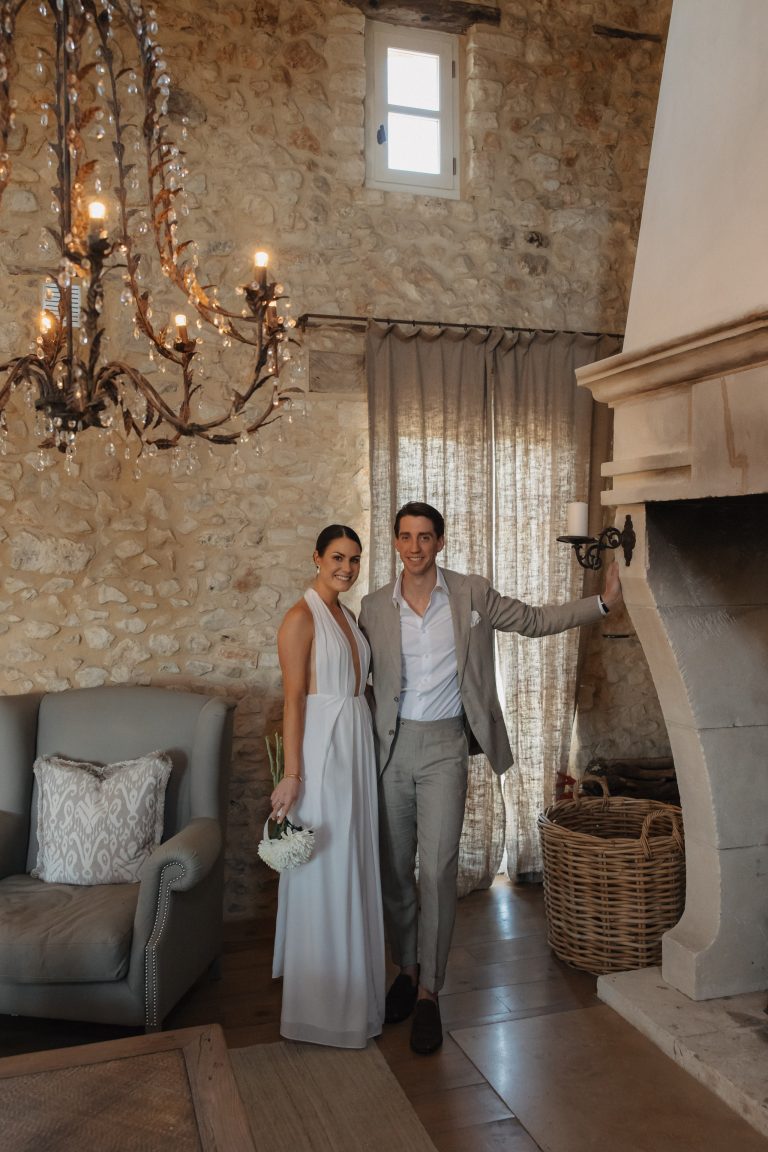
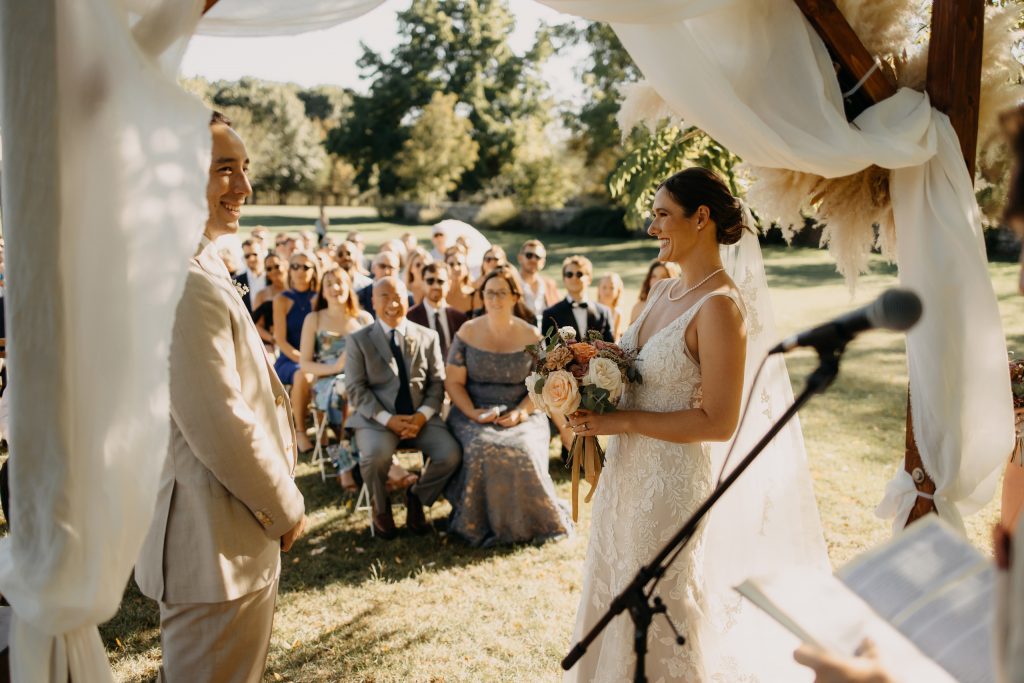 Michael & Michelle · Toulouse · see the full wedding →
Civil, religious or symbolic: which route?
| Route | Legal in France? | Where |
|---|---|---|
| Civil marriage | Yes | Town hall, mayor or deputy, with witnesses |
| Religious ceremony | Only after the civil marriage | Church or other place of worship |
| Symbolic ceremony | No legal effect | Anywhere you and the venue agree |
The service-public page says religious marriage may not be celebrated before the civil marriage. A symbolic ceremony is a non-legal celebration. French Wedding Style says in its symbolic ceremony guide that no licence is needed to officiate it and a celebrant costs €800 to €3,000 (a planner’s page, so an indication). For how the two compare, see our guide on symbolic versus legal wedding ceremonies abroad.
Documents by nationality
French law asks each of you for ID, proof of address dated more than a month before the banns (a mobile bill, bank details or a sworn statement are not accepted) and a full birth certificate with parents’ details: under 6 months old if you were born abroad, counted from the date you file. Foreign-language documents need a sworn translation. The official checklist for your case is the government’s document simulator.
On top of that, foreigners generally need a certificat de coutume, a certificate from your embassy or consulate that sets out the marriage rules of your country and confirms you are free to marry. If your country does not issue one, the mairie may accept a certificat de célibat, a certificate from your authorities or a lawyer, or a sworn statement. This is where the nationalities differ:
| You are | What the mairie may ask for | Where to start |
|---|---|---|
| UK | Proof you are free to marry; the UK service tells you which document applies | The UK government’s online service, then the mairie |
| US | Ask the mairie which paper it accepts in place of a certificat de coutume | The mairie, then the US Embassy and Consulates in France |
| Canada | Ask the mairie which paper it wants, then ask the embassy whether it issues it | The Embassy of Canada in Paris, listed on travel.gc.ca |
| Australia | A certificate of no impediment (certificat de coutume), issued by the embassy, valid 90 days | The Australian Embassy in Paris |
| Ireland | Ask the mairie which paper it wants, then ask Ireland’s Department of Foreign Affairs | The Irish Embassy in Paris |
What is official in that table, and what is not. The Australian line is the Australian Embassy’s own page: the embassy issues the certificate of no impediment, which it also calls the certificat de coutume, it is valid for 90 days from issue, and processing can take up to ten working days. The same page says the embassy cannot issue a certificat de célibat and points you to your state’s registry for a “no record of marriage” certificate. The UK line rests on the UK government’s general service, which names the certificate of no impediment and the marital status affirmation as examples but does not say which one a French mairie wants. For the US, Canada and Ireland we could not open an official page that sets out the French case, so we give no rule: the French page itself says that if your country issues no certificat de coutume, the mairie may accept alternatives such as a certificate from a lawyer or a sworn statement. Ask the mairie first, in writing, and then your embassy. As a practical estimate only, the planning site French Wedding Style’s guide for foreigners (updated July 2026) puts the time from start to submission at 4 to 5 months for UK couples and 4 to 6 months for US couples. Foreign documents may also need legalisation or an apostille: the French government’s legalisation page explains it and says a French translation by a qualified translator comes first.
Steps in order, with timing
- Choose the commune where one of you can show the required link, and phone the mairie. Ask whether you need an appointment to file.
- Collect the documents for each of you, using the simulator above. Order birth certificates so they are still valid on the filing date.
- File the dossier at the mairie. You also choose the order in which you will be named at the ceremony.
- Attend the hearing. The registrar hears you together and may interview each separately. It is mandatory unless impossible or considered unnecessary, and an interpreter can be requested. If you live abroad, a consulate may hold it.
- Banns are posted for 10 days at the town hall of the marriage and at the town hall where either of you lives. The wedding cannot take place before the 10th day after publication, and must take place within a year after that.
- Marry. A family booklet is given at the ceremony and you can order a certificate extract afterward.
All of this is on the service-public page. How early to file is not. French Wedding Style tells couples to file at least 30 to 40 days before the date and to start the paperwork 6 to 9 months ahead: that is a planner’s practical estimate, not an official deadline. We would start months early too, because collecting documents is the slow part.
 Edward & Rachel · Bordeaux · see the full wedding →
Where can the ceremony take place?
Inside the town hall, in a room open to the public, with the mayor or a deputy. The page adds that the mayor may use another communal building, such as a party hall, unless the public prosecutor objects. It does not list private châteaux or gardens. A legal ceremony at a private venue is therefore not something to assume: ask the mairie. In practice, couples who want a ceremony in a garden or on a terrace hold a symbolic one.
Is a French marriage recognised at home?
The UK government says a foreign marriage is recognised in the UK if it was lawful where it took place and would be allowed under UK law, and you cannot get a UK certificate for it. For the US, Canada, Australia and Ireland we did not confirm the rule, so check with your own government. The reverse also matters: a symbolic ceremony is not a legal marriage anywhere.
Why many couples marry legally at home and celebrate in France
Three reasons follow from the rules above: you do not need a month of residence in a French commune, you avoid sworn translations of your documents, and you do not need an embassy certificate for a French mairie. Many couples do the paperwork at home, sometimes weeks before, then hold the symbolic ceremony and celebration in France with every guest present. French Wedding Style says 80 to 90% of its international couples choose this route (a planner describing its own clients). To see what a wedding day in France looks like through our lens, browse Michael and Michelle in the south of France.
 Michael & Michelle · Toulouse · see the full wedding →
A timeline: what to do and when
| When | Do this |
|---|---|
| 12 to 6 months out | Decide legal at home plus symbolic, or legal in France. If legal in France, line up a month of residence and call the mairie. |
| 6 to 4 months | Ask your embassy about the certificate, order birth certificates with parents’ details, start translations. |
| 3 months | File the dossier. Check how old each document may be on the filing date. |
| 6 to 4 weeks | Hearing, then banns for 10 days. |
| Wedding day | Bring original IDs. Witnesses bring original ID too. |
Our destination wedding planning timeline for Europe covers the rest of the year.
two non-resident foreigners cannot simply book a French town hall. Phone the mairie first, and if the legal route looks heavy, marry at home and celebrate here.
FAQ: marrying in France as a foreigner
How to get married in France as an American?
You need the same French file as everyone (see the documents above) and a link to the commune. Ask the mairie in writing what it accepts in place of a certificat de coutume, then contact the US Embassy and Consulates in France. What is accepted can vary by town.
How to get married in France as a UK citizen?
Start with the UK government’s service for proof you are free to marry, then ask the mairie which form it wants. Marriages lawful in France are recognised in the UK if UK law would allow them.
How to get married in France as a Canadian or from Ireland?
The same French rules apply. We could not open an official page saying which certificate Canada or Ireland issues for a French mairie, so ask the mairie which paper it wants, then the Embassy of Canada in Paris or Ireland’s Department of Foreign Affairs. Australians can use the Australian Embassy’s page in the table above.
How to get married in Paris, France?
The national rules above apply in Paris too. You still need the commune link and the dossier, and a Paris town hall may have its own appointment system, so call the one you choose.
What legal requirements apply to wedding guests?
The service-public page lists requirements for the couple and for witnesses (name, birth details, profession, address, a copy of ID, original ID on the day). It lists nothing for guests. A symbolic ceremony has none. Guests’ entry to France depends on their passports.
What about a symbolic wedding in France if the legal marriage is in Poland?
A symbolic ceremony is allowed in France with no French paperwork, because it has no legal effect. For the legal marriage in Poland, ask the Polish authority: we did not research it.
Planning yours?
We document destination weddings across France with one shared documentary style. Photography and film packages from €1,390, no extra travel fees, book any package and change it later, with a 20% deposit to hold the date. Check your date or see prices. For the budget, read how much a wedding in France costs, or see our wedding photographer in France page.