Yes, a foreigner can marry in Portugal, and you do not have to live there.
In short: yes, foreigners can get married in Portugal, and two foreigners can marry each other there, with no residency requirement. The Portuguese registry institute (IRN) asks foreign partners for an identity document, a birth certificate and a certificate of capacity to marry issued less than six months before, or a statement that their country does not issue one. The process and registration cost €120, you file at least one month before the date, and you have 6 months after approval to marry. Many couples marry legally at home and hold a symbolic ceremony in Portugal. The legal act can be civil or Catholic; the section on church or civil ceremonies below shows how each changes the wedding day.
This guide is as of November 2026. Fees, document lists and registry practice change, and each registry (conservatória) applies the rules a little differently, so confirm your list with the office where you will marry. Nothing here is legal advice.
Can foreigners get married in Portugal?
Yes. The Ministry of Justice page on starting a marriage process does not ask for residency. For foreign partners it lists a autorização de residência, o passaporte ou documento equivalente, that is, a residence permit, a passport or an equivalent identity document. The 2022 Portugal.com guide and a BeachBride guide for US couples also say there is no residency requirement.
The basic conditions on the Ministry page: both partners must be at least 16, and those aged 16 to 18 need parental consent unless the registrar has waived it. Impediments include being already married and close family relationships. You can choose a civil wedding, a Catholic wedding or a civil wedding in a religious form.
Can you do it without a visa? Entry rules depend on your passport, and we do not give visa advice. As a guide, the UK government says British citizens can visit Portugal without a visa for up to 90 days in any 180-day period, and the passport must meet its issue-date and expiry rules. Everyone else should check their own government’s page and the Portuguese embassy.
 Andreas & Nina · Málaga · see the full wedding →
Portugal wedding legal requirements: the documents
The IRN page on organising the wedding lists what foreign partners bring to the registry:
- your identity document (passport);
- a birth certificate issued under the law of your own country;
- a certificate of capacity to marry (a document saying you are free to marry) issued by your own authorities less than six months before, or, if your country does not issue one, a statement that it does not;
- a certified Portuguese translation of any certificate or document not written in English, French or Spanish;
- a prenuptial agreement certificate if you have one, and a power of attorney if someone represents you (Ministry page).
So papers in English need no translation under this rule. The IRN page does not mention apostilles or legalisation, so ask the registry whether it wants them on your birth certificate. The table shows what each government says about proof that you are free to marry.
| Your passport | What your government says | Source |
|---|---|---|
| UK | Britons living outside the UK do not need a Certificate of No Impediment for Portugal; they are treated like Portuguese nationals | UK notice, June 2025 |
| US | Bring what Portugal asks of every foreigner (see the list above). Ask the US Embassy in Lisbon which document it offers as proof you are free to marry | US Embassy in Lisbon |
| Canada | Canada issues a statement in lieu of a certificate; Portugal may ask for a single status affidavit or marriage search record instead | travel.gc.ca |
| Australia | Ask the Portuguese registry which proof it wants, then ask the Australian government how to get it | Smartraveller / DFAT |
| Ireland | Ask the registry which proof it wants, then ask the Irish Department of Foreign Affairs how to get it | ireland.ie |
For the UK, the June 2025 notice from the British Embassy in Lisbon applies to British nationals resident in Portugal or in another country outside the UK. If you live in the UK, ask the registry which certificate it wants; the UK government has an online service for proof you are free to marry that needs a valid British passport. The UK marriage abroad page itself tells couples to ask the registry or the person conducting the ceremony about local rules.
For the US, we could not open the embassy’s own marriage page while checking this guide, so we do not repeat what other sites say about it. Use the IRN list above and contact the US Embassy in Lisbon for the current steps.
For Canada, the statement in lieu is a letter saying Canada does not issue certificates of non-impediment. It can be requested by email from Global Affairs Canada. The page warns that some foreign authorities want something else, such as a marriage search record or a single status affidavit, so check with the registry first. Portugal’s own rule accepts a statement that your country does not issue a certificate, which is what this letter is.
Translations. If a paper is in another language, Portugal’s note on the EU e-Justice portal says the translation can be made by a Portuguese notary, by the Portuguese consulate in the country where the document was issued, by that country’s consulate in Portugal, by a translator who swears to it before a notary, by a recognised chamber of commerce, or by a lawyer or solicitor.
How to get legally married in Portugal: the steps in order
- Pick the registry and a date. You can start at any civil registry (registo civil) in Portugal, not only the one near the venue, according to the Ministry page. Our own advice: choose the registry after you choose the venue, then ask it about your date.
- Ask for the document list. Do this before you order any certificates. The Linha Justiça helpline (800 910 220, weekdays 9:00 to 18:00) is listed on the Ministry page.
- Collect your papers. Your certificate of capacity must be less than six months old when you file, so do not order it too early.
- Start the process. Online filing is only open to Portuguese citizens, and Brazilians with equal rights, aged 18 or over with a Digital Mobile Key or Citizen Card. Foreign couples start in person at a registry, or send a representative with a power of attorney that gives special powers and names the future spouse, the property regime and the type of wedding. Appointments are booked free through the Siga portal or app.
- Pay and wait for authorisation. The process and the marriage record cost €120. Anyone may raise a reason why you cannot marry. If the file is refused you are notified and can appeal.
- Marry within 6 months of authorisation. See below for where and when.
- Order the marriage certificate. The Ministry page on asking for a marriage certificate gives €10 online and €20 on paper, from any registry or a Portuguese consulate abroad. This is what your home authority will want.
How long does it take? A timeline
The Ministry page says to organise the file at least one month before the chosen date. That is the official minimum. Gathering papers from your own country is usually the longer part, and the six-month limit on the certificate of capacity means timing matters, so we suggest this timeline:
| When | What to do | Why |
|---|---|---|
| 6 to 4 months before | Ask the registry for its list; order birth certificates | Some offices are slow |
| 4 to 2 months before | Get proof of status; translate if needed; file or send the power of attorney | Proof must be under 6 months old |
| 2 months to 1 month | Confirm authorisation; agree the place and time | One month is the official minimum |
| Wedding week | Bring passports and originals; arrive with time to spare | Ask about an interpreter in advance |
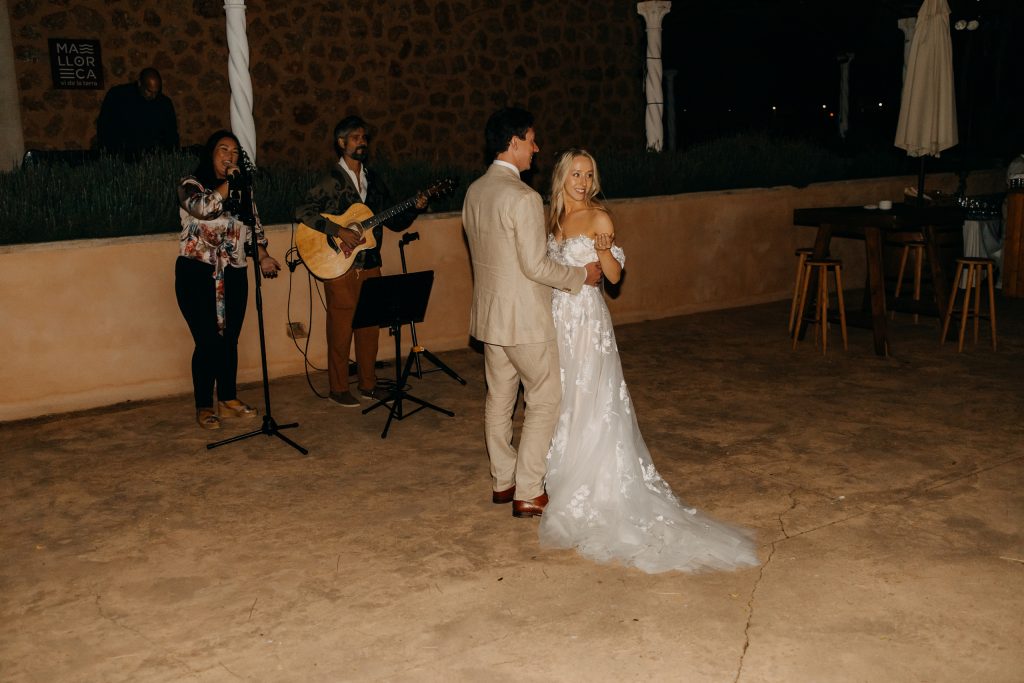 Christopher & Harriet · Mallorca · see the full wedding →
Where can the ceremony take place?
According to the IRN page, a civil wedding can be held at a registry during its normal opening hours. If you want another place, or a time outside opening hours, including weekends and public holidays, you agree the date and time with the registrar in advance. In Lisbon and the Algarve, public municipal spaces are available: the IRN names Lisbon City Hall and Albufeira City Hall. Ask the registry early whether it will hold the ceremony at your venue.
What it costs. On top of the €120, the IRN lists €200 for a wedding held outside the registry office, and €200 for one at the registry outside opening hours or on a Saturday, Sunday or public holiday. A prenuptial agreement adds €100 (standard regime) or €160 (a custom one). Ask the registry for the total for your date and place.
Language. The ceremony is a Portuguese civil act. The IRN says that if a foreign partner does not know Portuguese and the registrar does not speak that partner’s language, an interpreter is appointed. Ask the registry how this works and whether there is a cost.
Witnesses. Two to four witnesses may take part, but they are not required, per the IRN.
Can you marry at your own embassy instead? Not if you are Canadian: the Canadian government says no weddings are held at its embassies or consulates. Other nationalities should ask their own embassy. For the choice between a church and the registry, see the next section.
Church or civil ceremony in Portugal: how the wedding day changes
Portugal lets you choose a civil wedding, a Catholic wedding or a civil wedding in a religious form (Ministry of Justice page above). The paperwork is only part of the decision. The choice also decides where you stand, how long guests wait and how much light there is when you say your vows. We see the difference on the day, so here is how it plays out.
The civil route
- Where: at a registry, at a municipal space such as Lisbon City Hall, or at another place if the registrar agrees to travel (the IRN fees above apply).
- Length: short. The act itself takes a few minutes, which suits a small group and an elopement.
- Light: registry rooms and town halls are often bright, but you cannot choose the hour. If you want golden light, do portraits after the act, not before.
- Language: an interpreter is appointed if the registrar does not speak your partner’s language (IRN).
The church route
- Where: usually a Catholic church or chapel. Ask the parish priest about dates, preparation and what the church needs from foreign couples, and ask the registry how a church wedding is recorded, since each office handles the paperwork in its own way.
- Light: many Portuguese churches are dim inside, with stone, carved wood and tiles. We shoot them with fast lenses and no flash; ask the priest in advance where we may stand and move.
- Two places: the church and the reception are usually in different spots, so you need a transfer and a buffer. In Lisbon, Porto and Sintra old-town streets slow cars and limit parking.
- Heat and steps: cobbles, stairs and little shade outside are normal. Plan shade and water for guests if the day falls between June and September.
A day in each: sample timings
| Time | Civil ceremony at the venue | Church ceremony, reception elsewhere |
|---|---|---|
| Morning to midday | Getting ready at the hotel or venue; first look if you want one | Getting ready; portraits before the church while the light is still soft |
| Afternoon | Act and ceremony at 17:00 or 18:00, cocktails straight after | Church ceremony at a fixed time; leave 30 minutes for group photos outside; transfer |
| Evening | A short portrait walk before sunset (around 21:00 in late June), then dinner | Reception from about 19:00; couple portraits shortly before dinner if the sun is still up |
The first column keeps everyone in one place. The second asks for more planning but gives a church setting that no venue can copy. Many couples choose a third path: the legal act at home or at a registry on another day, then a symbolic ceremony at the venue at the best hour. A local planner, such as those in our guide to wedding planners in Portugal, can book the transfers.
Which one for which couple
Choose the church if the ritual and the building matter more than flexibility. Choose civil if you want a short act, a choice of hour and one location. Choose symbolic if you want the freedom of a cliff, a quinta or a beach and are happy to sign elsewhere. Whichever you pick, tell us the ceremony place and time when you check your date, and we will plan coverage around the light.
Same-sex couples
Portugal allows civil marriage between two people of the same sex under Law 9/2010 of 31 May 2010, which changed the Civil Code to define marriage as a contract between two people. Recognition at home depends on your country: Canada’s government says same-sex marriages are legal in Canada but that many countries do not recognise them, so check your own government’s advice.
 Nacho & Bea · Mallorca · see the full wedding →
Will the marriage be legal at home?
Usually yes, if it was legal where it took place, but each country decides. Canada says marriages legally performed abroad are usually valid in Canada and do not need to be registered there. For the UK, US, Australia and Ireland, check your own government’s page before you book. Ask the registry how to get the certificate you will need, and in which form your home authority wants it.
Symbolic wedding in Portugal: the other route
A symbolic ceremony has no legal effect. Couples hold it at the venue they love and sign the legal marriage at home, or at a registry in Portugal on another day. BeachBride notes that many couples choose this for more venue flexibility. It also avoids the certificate-of-capacity timing and the registrar’s fees for an outside venue, though you still need to marry legally somewhere. Our guide on symbolic versus legal ceremonies weighs the two, and our overview of where foreigners can legally marry in Europe compares countries. If it is just the two of you, see how to elope in Portugal.
call or write to the registry you plan to use, ask for its current document list in writing, and start 4 to 6 months ahead. Your embassy and the registry have the final word, not a blog, ours included.
Our photo and film packages in Portugal
We are a team of six photographers and filmmakers with one documentary style, and we cover weddings and elopements across Europe, Portugal included. Photography and film packages from €1,390, with no extra travel fees:
| Coverage | Photography | Film | Photo + film |
|---|---|---|---|
| 5 hours | €1,390 | €1,390 | €2,780 |
| 6 hours | €1,590 | €1,590 | €3,180 |
| 7 hours | €1,790 | €1,790 | €3,580 |
| 8 hours | €1,990 | €1,990 | €3,980 |
| Full day, no time limit | €2,190 | €2,190 | €4,380 |
An extra hour is €200, a second photographer +€890, a second filmmaker +€990 and a pre-wedding day +€890. A registry act in the morning and a symbolic ceremony later in the day fit an 8-hour or full-day package. Book any package and change it later if your plans change: a 20% deposit holds the date. Check your date and we reply within 24 hours, or see our prices and our page for a wedding photographer in Portugal.
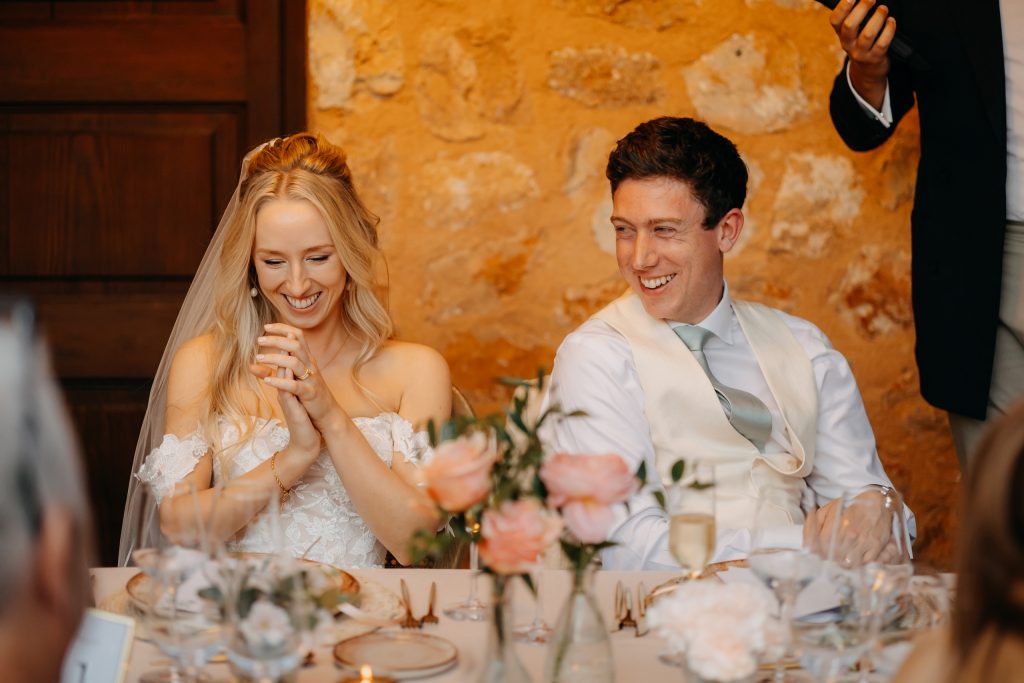 Christopher & Harriet · Mallorca · see the full wedding →
FAQ: marrying in Portugal as a foreigner
Do foreigners need to be residents to marry in Portugal?
No. The Ministry page asks for a residence permit, passport or equivalent ID, so a passport is enough for identification. You also need a birth certificate and proof you are free to marry, which the registry will name for your passport. Two foreigners can marry each other.
How can a US citizen get married in Portugal?
Follow the same Portuguese process as everyone else: passport, birth certificate, and a certificate of capacity to marry or a statement that the US does not issue one. Ask the US Embassy in Lisbon which document it provides, and confirm the list with the registry.
How can a Canadian get married in Portugal?
Start with the registry. Ask whether it accepts the statement in lieu from Global Affairs Canada, or wants a single status affidavit or a marriage search record, as the Canadian government lists them.
Is a Portuguese wedding legal in the UK?
A marriage that was valid where it took place is generally recognised, but confirm with the UK government before you book. A British citizen living outside the UK does not need a certificate of no impediment for Portugal, per the June 2025 notice from the British Embassy.
Is a church or a civil wedding better for photos in Portugal?
Churches are often dim and fixed in time, so we plan portraits before or after and ask the priest where we may stand. A civil wedding at a venue lets you choose the hour and keep everything in one place. Both work; the second needs less transport.
Can we have a symbolic wedding in Portugal?
Yes. A symbolic ceremony has no legal effect, so you also need a legal marriage, at home or at a registry in Portugal on another day. It is the usual choice for cliff, beach and quinta weddings, because the venue and the hour are yours to pick.