
In short: Couples who live elsewhere can marry legally in Denmark, Italy, Greece, Portugal, Norway, Iceland, Scotland, Croatia, Montenegro and Austria. France and Spain are the exceptions: both tie a civil marriage to living there. Denmark has the lightest paperwork, and Scotland allows a legal ceremony outdoors. Many couples sign the papers at home and hold a symbolic ceremony abroad, which is a sound choice too.
Legal, civil, religious, symbolic: what the words mean
- Legal ceremony: it creates the marriage in law. You leave with a marriage certificate from the country where you married.
- Civil ceremony: a legal ceremony led by a state official, such as a registrar or a mayor, usually at a town hall.
- Religious ceremony: legal only where the state gives it civil effect and the civil paperwork is done first. Otherwise it is a blessing.
- Symbolic ceremony: vows and rings with a celebrant or a friend, and no legal effect. No documents, no waiting period, any place, any hour.
Why do so many couples marry on paper at home? The forms are in their own language. There are no apostilles, translations or visa questions. And the ceremony abroad is free of office hours: it can happen on a cliff at sunrise or in a garden at 19:00, when the light is best. A town hall rarely offers either.
decide between legal and symbolic before you choose the country. That choice changes the shortlist, the timeline and the budget more than anything else.
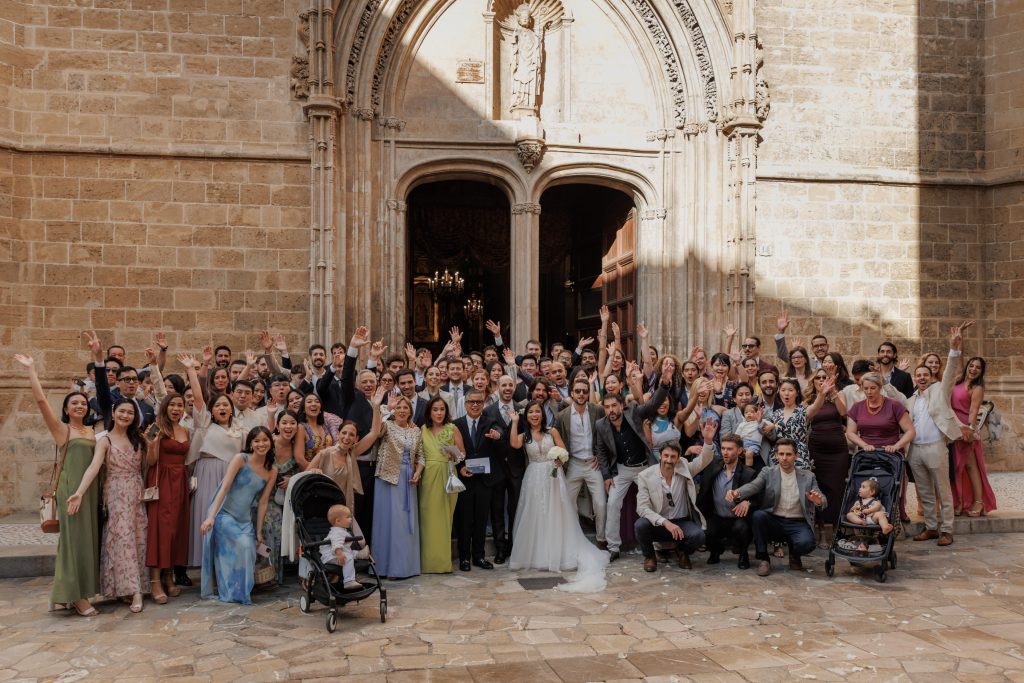 Nacho & Bea · Mallorca · see the full wedding →
12 countries compared
All facts are as of November 2026 and come from the official pages linked in the next section. Fees and forms change, so check the page before you apply. Where we could not confirm a point, the table says so.
| Country | Legal for non-residents? | Typical lead time | Main hurdle |
|---|---|---|---|
| Denmark | Yes | Certificate in about 5 working days once complete. Copenhagen City Hall slots: up to 4 months | Online application, DKK 2,100 |
| Italy | Yes | Check with the registry. Papers stay valid 3 to 6 months | Nulla osta and sworn statements |
| Greece | Yes | Check with the registry | Apostilles, official Greek translations |
| Spain | Only if one of you lives in Spain | Check with the registry | Domicile in Spain |
| France | Only with a home or a month’s residence in the commune | Banns posted for 10 days | The residence rule |
| Portugal | Yes | Start at least 1 month ahead | In person or by proxy at a registry |
| Norway | Yes | Up to 5 weeks for the certificate | Original apostilled papers by post |
| Iceland | Yes | Check with the registry | Marital status certificate under 12 weeks old |
| Scotland (England and Wales differ) | Yes | Notice 29 days to 3 months ahead | Visa for many visitors |
| Croatia | Yes | Usually 30 to 45 days after you declare | Papers with Croatian translation |
| Montenegro | Yes, per embassy guidance | Check with the registry | Rules differ by municipality |
| Austria | Yes | No minimum wait | Usually both in person first |
Country by country
Denmark
You apply online to the Agency of Family Law (Familieretshuset) for a certificate of marital status. The fee is DKK 2,100. As a general rule the certificate arrives within 5 working days when nothing is missing, and it is valid for four months. You must be able to enter and stay in Denmark legally. Then you book a municipality. At Copenhagen City Hall the wait for a slot can be up to four months. Our City Hall guide covers the day itself.
The full steps are in our guide to getting married in Denmark as a foreigner.
Italy
Visitors can marry in a civil ceremony at a town hall (comune). You need a nulla osta, a statement from your own country that nothing prevents the marriage, or the equivalent for your nationality. US citizens swear an Atto Notorio at an Italian consulate (valid 90 days) and a second statement at a US consulate in Italy, as the Italian consulate in San Francisco explains. The comune of Lucca, as one example, takes bookings six months ahead and sees both of you in person two or three days before the wedding, with an interpreter if needed. See church or civil in Italy.
The full steps are in our guide to how to elope in Italy.
Greece
Foreigners who live abroad can have a civil wedding at a Greek town hall. The Municipality of Chania publishes a typical list: a marriage licence or certificate from your home authority that names both of you, recent birth certificates and passport copies, with apostilles and official Greek translations. Each municipality sets its own details and timing, so write to the one you choose. See church or civil in Greece.
The full steps are in our guide to how to elope in Greece.
Spain
A civil marriage file is opened at the Civil Registry, or with a notary, where one of you is domiciled, according to the Spanish government’s guide. Two visitors with no home in Spain have nowhere to open it, which is why most foreign couples hold a symbolic ceremony there. More in city hall or church in Spain.
France
The civil ceremony takes place in a commune where one of you, or one of your parents, has a home, or where one of you has lived for at least a month before the banns go up. Banns are then posted for 10 days. Service-Public states that two foreigners who do not live in France marry at their own consulate, not at a town hall in mainland France. That is why château weddings for visitors are almost always symbolic.
Portugal
You start the process at any civil registry office (Conservatória do Registo Civil), in person or through a representative with a power of attorney, at least one month before the date. It costs €120, and once it is approved you have six months to marry, says the Ministry of Justice. Foreigners identify themselves with a passport. Ask the registry which documents from home it needs and in what form.
Norway
You each send forms and original papers to the Tax Administration (Skatteetaten): a certificate of no impediment from your home country, no more than four months old, with an apostille or legalisation, in English or a Nordic language. Citizens from outside the Nordic countries also show that they are in Norway lawfully. Skatteetaten quotes up to five weeks for the check. The certificate it issues is valid for four months and goes to your officiant.
The full steps are in our guide to how to elope in Norway.
Iceland
The District Commissioner (Sýslumaður) checks your papers and issues a certificate of no impediment. Island.is lists birth certificates, a certificate of marital status no more than 12 weeks old when you submit it, and ID. Processing times differ between offices, so ask the one you use.
The full steps are in our guide to how to elope in Iceland.
Scotland, with England and Wales
In Scotland a registrar or an authorised religious or belief celebrant can marry you at any indoor or outdoor location, says National Records of Scotland. Each of you sends an M10 notice between three months and 29 days before, and pays £45. Most visitors from outside the UK and Ireland need a Marriage Visitor visa (£135). England and Wales are stricter: you live in the registration district for seven days before giving notice, then wait at least 29 days, and civil ceremonies take place at register offices or approved venues (gov.uk).
The full steps are in our guide to how to elope in Scotland.
Croatia
You declare your intention to a registrar, who normally sets the ceremony 30 to 45 days later. A civil ceremony costs €27.87, with an extra fee outside official premises, according to gov.hr. Foreign citizens bring a birth record, a single-status certificate and confirmation that nothing prevents the marriage, each with a Croatian translation (Ministry of Justice).
Montenegro
Marriages are arranged by the municipality. We found no English checklist from the Montenegrin government. The Australian Embassy that covers Montenegro lists a certificate of no impediment, an apostilled birth certificate no more than six months old and a passport, and warns that municipalities may ask for more. Write to the registry in Kotor, Budva or wherever you plan to marry before you order documents. See church or civil in Montenegro.
The full steps are in our guide to eloping in Montenegro.
Austria
People with no Austrian citizenship or residence can marry at any registry office (Standesamt), states oesterreich.gv.at. Usually both of you appear in person for the check of your capacity to marry. The result is valid for six months and there is no minimum wait before the ceremony. The fees are €74 for the check and €193 for foreign documents. See church or civil in Austria.
Apostille, legalisation and sworn translations
- Apostille: a certificate that the issuing country attaches to a public document, such as a birth certificate, so that another country accepts it as genuine. It works between the 130 members of the Hague Apostille Convention. You get it at home, from the authority for the place that issued the document.
- Legalisation: the older route for countries outside the convention: a chain of stamps that ends at a consulate of the country where you will marry.
- Sworn translation: a translation by a translator the receiving country recognises. Greece and Italy are strict about who may translate, so ask before you pay.
- Inside the EU: birth and marital-status certificates need no apostille between member states, and a multilingual standard form can replace the translation (Your Europe).
Watch the dates. Norway wants certificates under four months old and Iceland under 12 weeks. Order them late enough to be valid and early enough to be stamped and translated.
 Jacky & Jordan · Positano · see the full wedding →
Getting your marriage recognised at home
A marriage that is valid where it took place is normally valid at home, but each country has its own formalities.
- UK: recognised if it was lawful where it happened and would be allowed under UK law. You cannot get a UK certificate for it, so keep the foreign one (gov.uk).
- Canada: usually valid, with no need to register it (travel.gc.ca).
- EU countries: you usually register it in your home country under its rules (Your Europe).
- US and Australia: there is no home registration to complete. Recognition follows state law in the US and national law in Australia, so confirm with your state authority or with Smartraveller before you travel.
Ask for several certified copies of the marriage certificate before you fly home, and a multilingual version where one exists. Copenhagen hands you two multilingual certificates after the ceremony. If your home authority wants an apostille on the certificate, get it before you leave the country.
Same-sex marriage: where it is legal
Marriage is open to same-sex couples in Denmark, Spain, France, Portugal, Norway, Iceland, Austria, Greece (since 2024), Scotland, and England and Wales.
- Italy: a civil union (unione civile), not marriage.
- Croatia: a life partnership before a registrar, on similar steps to a marriage (gov.hr).
- Montenegro: a life partnership law adopted in 2020, not marriage. Check with the registry whether visitors can use it.
Recognition at home varies. An EU country that does not allow same-sex marriage does not have to give yours full effect under its national law. We photographed two grooms in Copenhagen, where the process is the same for every couple.
A simple timeline
- 6 to 9 months before: choose legal or symbolic. Write to the registry and ask for its current list.
- 3 to 4 months before: order certificates, apostilles and translations. Apply for a UK marriage visa if you need one (three months before travel at the earliest).
- 1 to 3 months before: submit. Norway needs up to five weeks, Scotland at least 29 days, Portugal at least a month.
- Final week: carry originals in hand luggage and arrive two or three days early if the registry wants to see you first.
 Jacky & Jordan · Positano · see the full wedding →
FAQ: getting legally married in Europe
Which European country is easiest for foreigners to marry in?
Denmark. One online application, one fee and a certificate that usually arrives within days. Book the town hall early, because popular ones fill up.
Can we legally marry in France or Spain as visitors?
Normally not. France needs a home or a month’s residence in the commune, and Spain opens the file where one of you lives.
Is a symbolic ceremony a real wedding?
It is real to you and your guests, but it has no legal effect. You sign the legal papers separately, usually at home.
Do we need an apostille on our documents?
Often, yes. Greece, Norway and Montenegro, for example, ask for one on foreign certificates. Between EU member states, civil-status certificates are exempt.
Is a marriage in Europe valid in our home country?
Usually, if it was valid where it took place. Check your own country’s rule before you book.
Once the legal route is clear, choose the place: the best places to elope in Europe, compared by month, crowds and access. Then put the steps in order with the 12-month planning timeline.
Planning yours?
We are a team of six photographers and filmmakers with one documentary style, working across Europe. Legal or symbolic, we record the day as it happens. More guides are in our ceremony and legal section.
Send us your date and country through the contact page and we reply within 24 hours. Prices and a calculator are on the investment page.