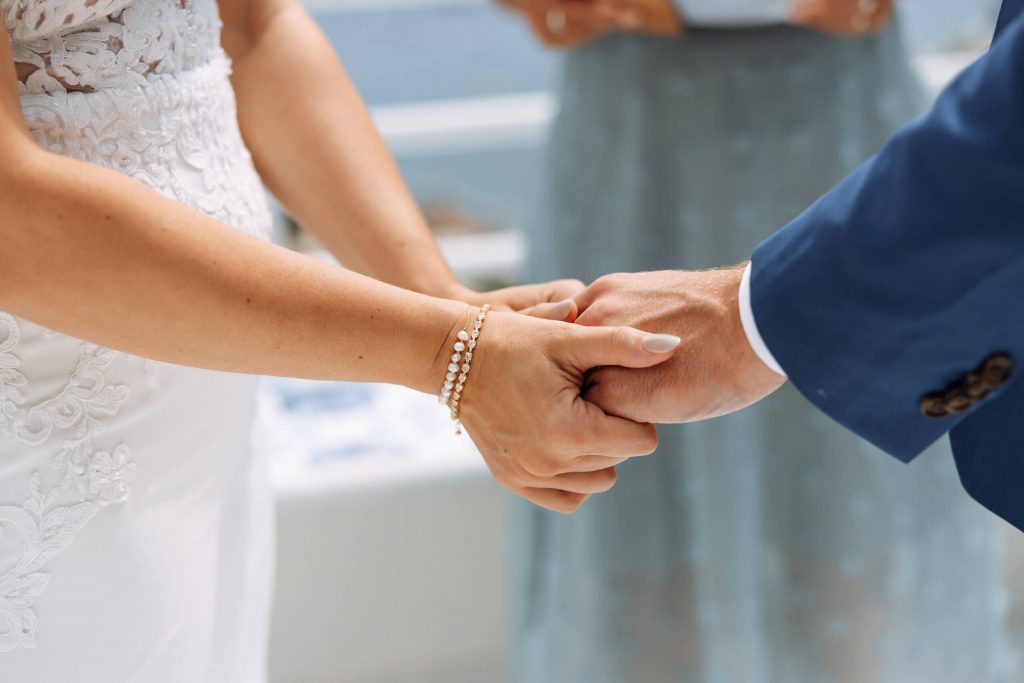
In short: Yes, two foreigners can marry legally in Italy, and there is no residency requirement. The paperwork has to be finished in person in Italy in the days before the ceremony, and it differs by passport. That is why most couples who elope here sign the legal papers at home and hold a symbolic ceremony in Italy, which can happen anywhere, at any hour, with no documents. Plan the ceremony for the last two hours of light and avoid August if you can.
Who an Italian elopement suits
Italy works for two people, or a couple with a handful of guests, who care more about the place and the evening than about a party, and who are happy to walk. The best corners of Positano, Venice and the Dolomites are reached on foot, by stairs or by boat. It suits you less if you need a legal ceremony on a clifftop at sunset in August. Our elopement guides cover other countries.
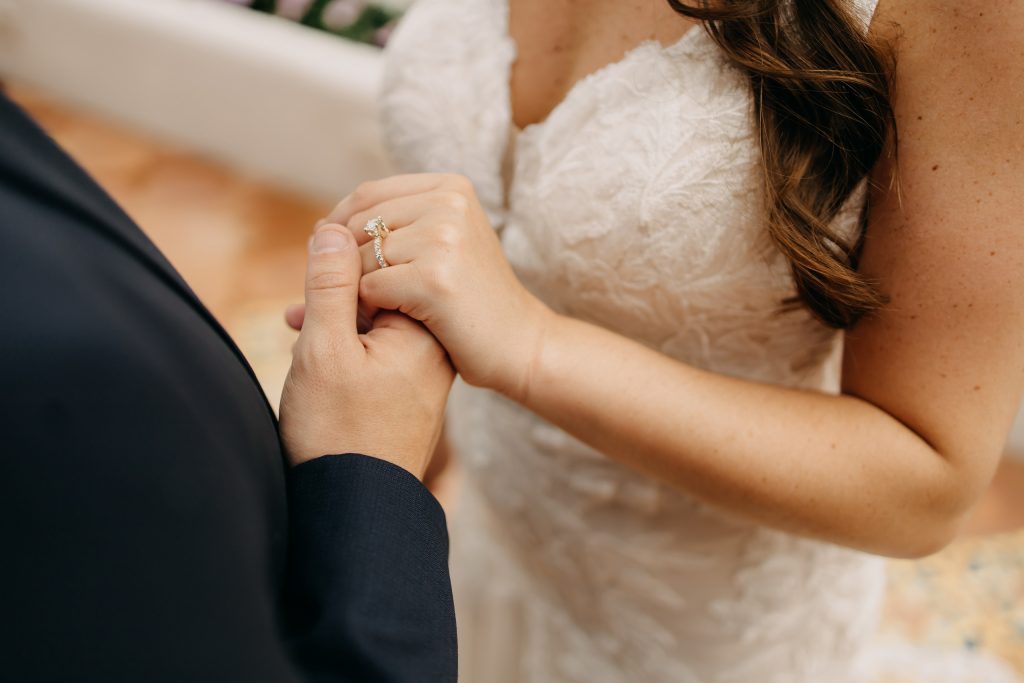 Alex & Georgi · Positano · see the full wedding →
Legal, religious or symbolic: the three routes
| Route | Where | Paperwork | Legal in Italy |
|---|---|---|---|
| Civil | Town hall, or a venue the town has approved | Full file, in person | Yes |
| Catholic | A church, with a priest | Civil file plus church file | Yes |
| Symbolic | Anywhere you are allowed to stand | None | No |
Civil ceremony. The mayor or a deputy marries you in Italian, with two witnesses and an interpreter if you need one. The comune (the municipality) decides which rooms and hours are available. Some towns have approved a terrace or garden, but you cannot hold a legal ceremony on any beach or rooftop you like.
Religious ceremony. The US Embassy in Italy explains that a ceremony performed by a Roman Catholic priest is legally valid, because the priest registers it with the civil authorities. A ceremony led by other clergy needs a civil ceremony first. See our guide to church and civil ceremonies in Italy.
Symbolic ceremony. A celebrant or a friend leads it. It has no legal effect, so you marry at home before or after. Most foreign couples who elope choose this route: the legal file takes several working days in Italy, the consular step may be in another city, and the town hall limits the place and the hour.
Same-sex couples can register a civil union in Italy, not a marriage.
decide legal or symbolic before you choose the location. A legal ceremony ties you to one town hall, its approved rooms and its office hours. A symbolic one lets you choose the place and the minute.
Paperwork for a legal civil wedding
This is the outline as of November 2026. Each town hall reads the law slightly differently, so ask its marriage office (Ufficio Matrimoni) for its own list, and check the official pages linked here before you apply. Fees and forms change.
- Write to the comune. Ask for its document list, free dates, the hall fee and how many days ahead you must appear.
- Collect documents at home: passports, birth certificates, proof that any earlier marriage has ended. Certificates need an apostille and an Italian translation, and Italy accepts non-EU documents for six months from issue.
- Get proof that you are free to marry. Italy calls it a Nulla Osta, a certificate that nothing stands in the way.
- Get an Atto Notorio if your nationality needs one (US and Australian citizens do). It is a second declaration, sworn with witnesses before an Italian consul abroad or a court in Italy.
- Legalise the consular document at the Prefettura, the local office of the national government, with a €16 revenue stamp (marca da bollo) bought at a tobacconist.
- Declare your intention to marry at the town hall, with an interpreter if you do not speak Italian. Banns (public notice) are waived or shortened when neither of you is Italian or resident in Italy.
- Marry, with two adult witnesses who carry photo ID. A witness cannot also be the interpreter.
- Collect the marriage certificate and have an apostille added at the Prefettura.
What changes by passport
- United States. You swear a Dichiarazione Giurata (an affidavit that you are free to marry) at the US Embassy in Rome or a consulate in Milan, Florence or Naples, then legalise it at a Prefettura in the same consular district. The embassy advises getting the Atto Notorio from an Italian consulate before you fly. It describes two witnesses, and some consulates ask for four. The Naples district page says the Atto Notorio is generally not needed on the Amalfi Coast.
- United Kingdom. GOV.UK treats the Nulla Osta as a certificate of no impediment (CNI). Its marriage abroad service shows which documents you need. British nationals already in Italy can apply to the embassy in Rome by post with a notarised notice. For UK residents, the Italian Consulate General in London describes a CNI from your register office and a statutory declaration before a solicitor or notary, each with a paper apostille. That page covers couples with one Italian partner, so ask your comune to confirm.
- Canada. Only the Embassy of Canada in Rome issues the Marriage Nulla Osta. You swear an affidavit before a notary in Canada or at the embassy and can apply by mail. It costs CAD 50 per person, plus CAD 50 if sworn at an embassy, and normally takes five business days.
- Australia. The Australian Embassy’s information sheet asks for an Atto Notorio from an Italian consulate in Australia before you leave, and a Nulla Osta sworn in person at the embassy in Rome or the consulate-general in Milan. Declarations sworn outside Italy are not accepted. The sheet lists the euro equivalent of A$80 per person.
Lead times
- 6 to 9 months before: choose the town, write to the comune, reserve the hall.
- 3 months before: order fresh birth certificates with apostilles and start your free-to-marry document.
- 1 month before: book the consular appointment in Italy, the interpreter and translations.
- Final week: consulate, Prefettura, town hall, ceremony. The US Embassy says to allow several days and warns of waiting lists in May, June and September. We would plan at least four working days.
Best places for two people, with honest notes
- Positano and the Amalfi Coast. Positano is a vertical town. One road loops through the top, and almost everything below it is stairs. We have photographed elopements on a rooftop above the town, and the rooftop is the point: the view without the crowd on the beach. Three hundred metres on a map can be 15 minutes of steps. Wear flat shoes until the ceremony and let the hotel porter carry the dress. Ferries stop when the sea is rough, so never arrive by boat on the day. More in our notes on Positano stairs and boats.
- Lake Como. Varenna and Bellagio are small and full by late morning from May to September. Go at sunrise or after 18:00, or take a private boat to a quiet shore. Summer storms build in the afternoon, so keep a covered option.
- Dolomites. Alpe di Siusi, Seceda, Lago di Braies and Tre Cime sit at roughly 1,500 to 2,500 metres. Cable cars run only in daytime, and road access to some places is restricted on summer days, so check current rules before you fix an hour. Sunrise is calmer. Expect afternoon thunderstorms in July and August. See our Braies, Seceda and Alpe di Siusi notes.
- Tuscany. Val d’Orcia and Chianti are about space: cypress roads, vineyards, farmhouses. You need a car, and Florence to Pienza is about two hours. Most good spots are private land, so base the day at one villa or agriturismo (a working farm with rooms).
- Venice at sunrise. At 06:00 St Mark’s Square and the small bridges are close to empty. By 10:00 they are not. Plan for sunrise, move on foot and by water taxi, and expect steps on every bridge. Acqua alta, the seasonal high water, is mostly an autumn and winter problem. Details in our Venice elopement guide.
- Puglia. Flat, easy to drive and calmer than the Amalfi Coast: whitewashed towns such as Ostuni, olive groves, and masserie (fortified farmhouses turned into hotels). Summer is very hot with little shade.
- Sicily. Distances are big. Palermo to Taormina is about three hours by car, so choose one corner. Taormina is steep and busy, Ortigia in Syracuse is flat and walkable.
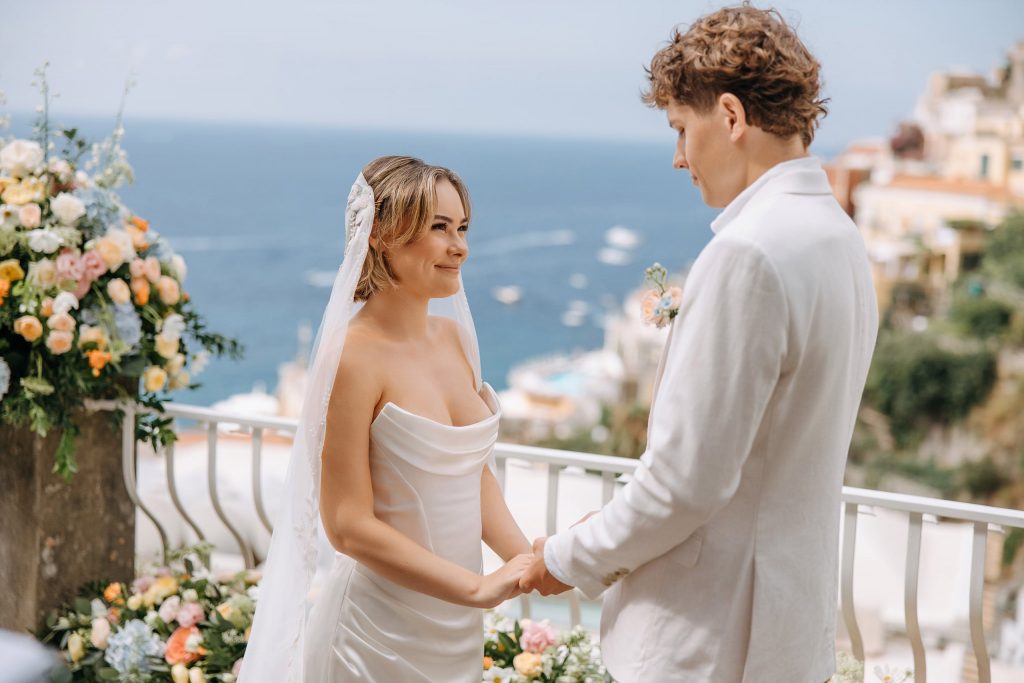 Kyrisma & Benjamin · Positano · see the full wedding →
Best months and time of day
| Months | What to expect | Good for |
|---|---|---|
| April, May | Mild, green, some rain. Not every boat or cable car is running | Tuscany, Venice, Puglia, Sicily |
| June | Long days, warm sea, busy from mid month | Everywhere |
| July, August | 30 to 35°C in the south and inland, peak crowds and prices | Dolomites, lakes at sunrise |
| September | Warm, softer light, coast still busy | Everywhere |
| October | Quiet, shorter days, more rain, fewer boats | Tuscany, Sicily, Puglia, Venice |
In late June the sun sets at about 20:35 on the Amalfi Coast and about 21:00 in Venice and the Dolomites. In mid September it sets between 19:10 and 19:25. Start an evening ceremony 90 minutes before sunset. Sunrise in the north is about 05:20 in late June and 06:50 in mid September.
the hour matters more than the place. Midday sun in an Italian summer is hard and hot. If the town hall only offers 11:00, do the legal part then and keep the vows and portraits for the evening.
What it costs
Our prices. Photo and video cost the same, each on its own: up to 5 hours €1,390, 6 hours €1,590, 7 hours €1,790, 8 hours €1,990, a full day with no time limit €2,190. Photo plus video is the plain sum, so €4,380 for a full day. Travel to and from your venue is included, and a 20% deposit reserves the date. Most elopements fit in 5 or 6 hours. You get a sneak peek within days, the gallery in 3 weeks and the film in about a month.
Official fees for the legal route.
- €16 revenue stamp for each document legalised at the Prefettura.
- Atto Notorio at an Italian court: two €16 stamps plus one of €10.62 (ready in 4 to 10 days), or one of €31.86 in place of the €10.62 for same-day issue (US Embassy figures).
- Marriage hall rental: it depends on the town, season and weekday. The US Embassy gives a range of €500 to €9,200.
- Consular fees: see your passport above. US consulates charge a notarial fee per affidavit.
Everything else (celebrant, interpreter, flowers, a boat, the room) has no fixed price. Season and address drive it, and the Amalfi Coast, Lake Como and Venice in summer sit at the top.
A sample day: evening ceremony in Positano, late June
- 14:00 Hair and make-up in the room.
- 16:30 We arrive. Details, letters, getting ready in two rooms.
- 17:30 First look on the terrace or a quiet stairway. Allow 15 minutes.
- 18:00 A walk through the upper lanes as the day visitors start to leave.
- 19:00 Ceremony on the rooftop, about 20 minutes.
- 19:30 A toast, then portraits. The sun drops behind the hills west of town before the official sunset at 20:35, so the light turns soft early and lasts.
- 20:45 Blue hour as the town lights come on.
- 21:00 Dinner for two. Five hours of coverage end at 21:30.
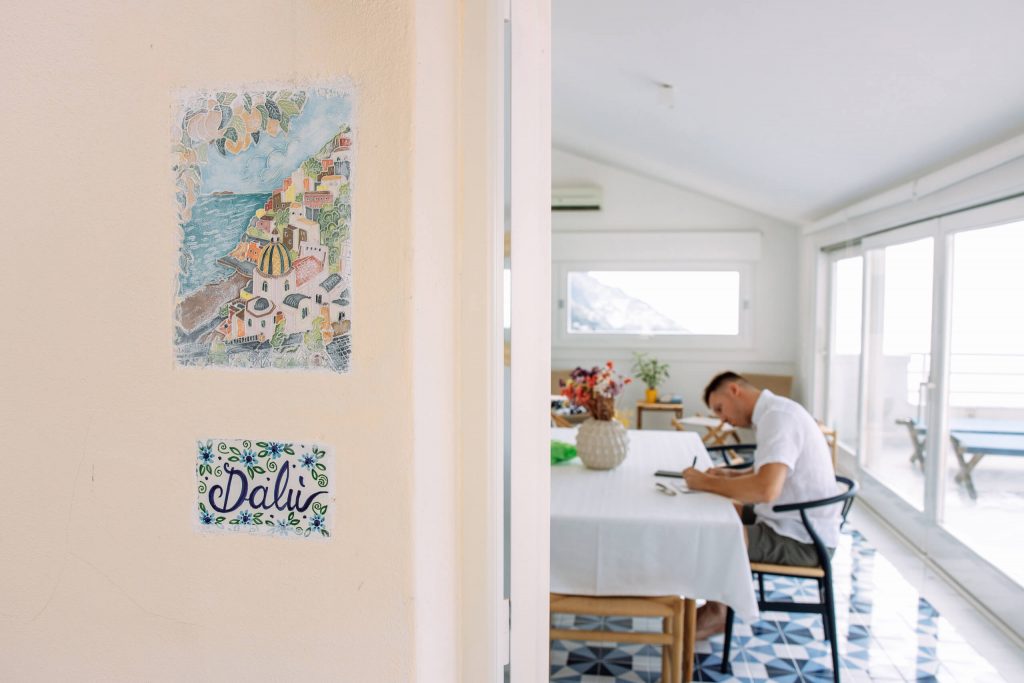 Jacky & Jordan · Positano · see the full wedding →
Common mistakes
- Planning a legal ceremony inside a three-day trip.
- Bringing birth certificates issued more than six months before the wedding.
- Arriving by ferry, or driving the coast road, on the day itself.
- A midday ceremony in July or August.
- Three regions in one week, heels on stairs, and no covered backup for a storm.
FAQ: eloping in Italy
Can foreigners legally get married in Italy?
Yes, and neither of you has to live in Italy. You need passports, proof that you are free to marry, a declaration at the town hall and two witnesses.
How many days before a legal wedding do we need to be in Italy?
Allow at least four working days for the consulate, the Prefettura and the town hall, and ask your comune how far ahead it wants to see you.
Is a symbolic ceremony a real marriage?
It is a real ceremony with no legal effect. You sign the legal papers at home.
What is the best month to elope in Italy?
Late May, June and September for most regions, and mid June to late September in the Dolomites.
Do US, UK, Canadian and Australian travellers need a visa?
Not for stays of up to 90 days in any 180 in the Schengen area. The EU’s ETIAS travel authorisation was not yet in operation when we wrote this, so check before you fly in 2027.
Still choosing a country? Compare the best places to elope in Europe and check where foreigners can legally marry. To plan the hours of the day, use our timeline for the best light.
Planning yours?
We are a team of six photographers and filmmakers with one documentary style: we follow the day and do not stage it. We work across the country as a wedding photographer in Italy, and our Italy guides cover regions in detail.
Tell us your date and the area you have in mind. Check your date here and you will hear from us within 24 hours. Prices and a calculator are on our investment page.