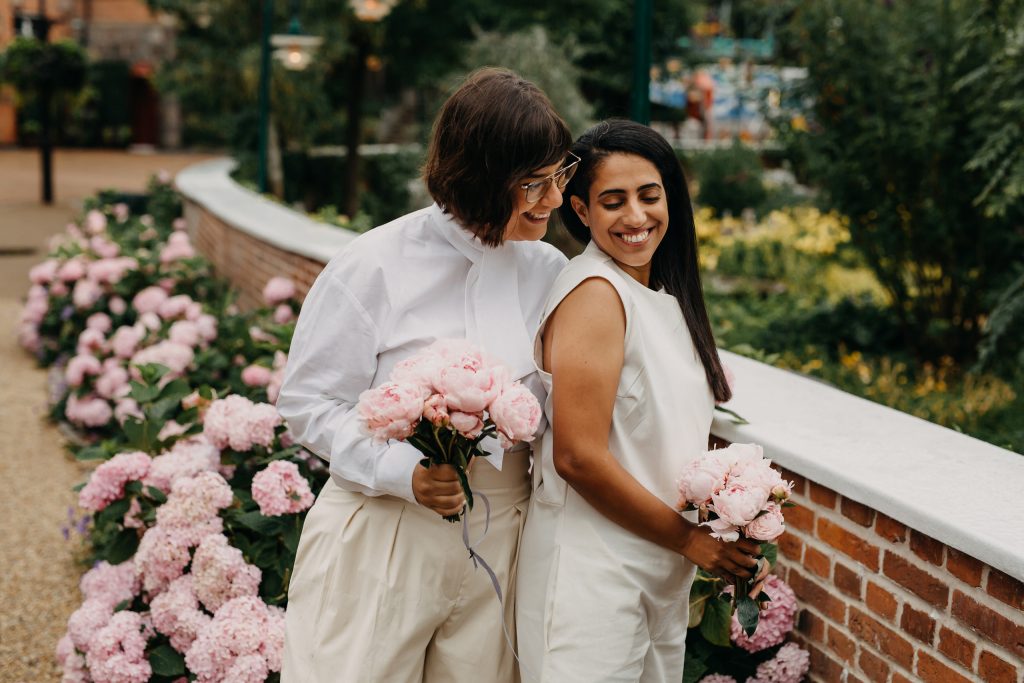
In short: Yes, two foreigners can legally marry in Denmark, and it is usually quicker than at home. You apply online to the Danish Agency of Family Law (Familieretshuset), pay DKK 2,100 and receive a certificate of marital status that is valid for four months. With it you book a short civil ceremony at a town hall such as Copenhagen City Hall, Ærø or Tønder. A complete application can be approved within 5 working days, so most couples can plan everything in two to three months.
Why Denmark is easier, and who it suits
Denmark asks for fewer papers than most of Europe. There is no residency requirement. The official checklist covers your passports, your right to enter Denmark and proof that you are free to marry. Your own birth certificates are not on it. Same-sex and different-sex couples marry on the same terms, and ceremonies are held in English, German or Danish.
This route works well for:
- couples with two nationalities who face double paperwork at home
- same-sex couples whose home country does not offer marriage
- couples where one partner is from outside the EU and travels on a visa or visa-free
- couples who want a quick legal wedding now and a bigger celebration later
Both of you must be at least 18, unmarried, not closely related and able to enter Denmark legally. The agency also checks that the marriage is genuine.
 Romain & Bruno · Copenhagen · see the full wedding →
Step 1: the certificate from Familieretshuset
Familieretshuset is the state agency that decides whether a couple meets the conditions of the Danish Marriage Act. If either of you is not a Danish or Nordic citizen and has no permanent right to live in Denmark, you apply to this agency, not to a town hall. The result is a certificate of marital status (prøvelsesattest), which is your licence to marry. The facts below are as of November 2026. Fees and forms change, so check the official page before you apply.
- Open the digital form on the agency’s page Apply for a Certificate of Marital Status. Without MitID, the Danish digital ID, you create a profile with your email address.
- Each partner fills in their own part. If the agency does not have both parts within 14 days, it closes the case and you pay again.
- Name the municipality where you want to marry and upload your documents.
- Pay the fee in the payment window: DKK 2,100 in 2026. It is adjusted every year and is not refunded once you submit.
- Wait for the decision. The agency says you can expect the certificate within 5 working days when nothing is missing. If it has to ask you for more, the wait is much longer: in November 2026 it was working on such cases from August.
- Book your ceremony. The certificate is valid for four months from the date of issue, or less if your passport, visa or residence permit expires sooner.
the four months start on the day of approval, not on the day you apply. Apply about three months before your date, and do not buy flights until the town hall has confirmed your slot.
Documents for each situation
Everything is uploaded as colour photos or scans. Papers that are not in Danish, English or German need a translation by an authorised translator, and you send the original and the translation together.
- Everyone: photos of every page of your passport, covers and blank pages included. EU citizens may use both sides of a national ID card.
- Single, living outside Denmark: a certificate of marital status from the country where you live now.
- Divorced: the divorce decree. Widowed: the death certificate of your spouse. An annulment judgment also counts.
- Living together abroad: a residence certificate or similar proof of your shared address.
- Children together: their birth certificates.
- Non-EU partners: proof of legal entry and stay. Your passport must be valid at least 3 months beyond your stay, have 2 empty pages and be less than 10 years old. Add your visa or residence permit if you need one.
For entries after 10 April 2026 the agency no longer relies on a passport stamp. Non-EU citizens send a printout from the EU Entry/Exit System calculator, plus plane tickets or boarding passes if they have already entered. A residence permit from a Schengen country is enough on its own.
Whether your papers need an apostille depends on where they were issued. Under the agency’s documentation rules, papers from the US, Canada, Australia, New Zealand, Turkey, Great Britain and most of continental Europe normally need neither apostille nor legalisation. Papers from most other countries do, and the stamp has to be translated too.
The agency may ask how long you have known each other, where you met and whether you live together. It can also invite you to an interview. Photos of you as a couple are not required, but it can ask for them.
Step 2: choose and book the town hall
Any Danish municipality can marry you, and you name it in your application, so decide before you apply. You book the date after approval, through a link or an email from the town hall.
| Town hall | Ceremony times | Witnesses | Good to know |
|---|---|---|---|
| Copenhagen City Hall | Mon to Fri 09:10 to 15:50, Sat 10:00 to 12:40 | Two official witnesses always provided | Up to 75 guests, about 10 minutes, waiting time up to four months |
| Ærø (island) | More than 200 wedding dates a year | Ask the wedding team | Town hall or outdoor spots, a date within 7 to 8 weeks, ferry needed |
| Tønder (German border) | Tue and Thu 09:30 to 12:00, afternoons with your own witnesses | Provided free | No extra ceremony cost, closed two weeks in late July in 2026 |
| Langeland (island) | Ask the municipality | Provided if you have none | Official information in Danish only |
Copenhagen is the easiest to reach and the best for photos, but the city says the wait for a City Hall slot can be up to four months. That is as long as your certificate lasts, so ask the Wedding Office about current dates before you apply. The city also offers open-air weddings on selected days and a registrar at a place of your choice inside the city limits. Our guide to Copenhagen City Hall slots and timing goes deeper.
The islands and small towns are calmer. Ærø has a dedicated wedding team and offers a date within 7 to 8 weeks of receiving your certificate. Tønder marries couples in its registry office opposite the town hall. Langeland publishes its rules in Danish only, so write to the municipality first.
How long must you be in Denmark? The agency’s pages set no minimum stay. Town halls differ: Aabenraa, for example, states that there is no mandatory overnight stay and checks your travel documents in the waiting area. Bring the same passports you uploaded. We advise arriving the day before anyway.
Witnesses and language. Two witnesses must be present. Copenhagen, Tønder, Aabenraa and Langeland supply them if you come alone. The ceremony is in English, German or Danish, and for any other language you bring an interpreter.
 Ronna & Liad · Copenhagen · see the full wedding →
The marriage certificate and using it at home
You leave the ceremony with two international marriage certificates in five languages: Danish, English, German, French and Spanish. A Danish wedding does not change your name if you are not registered in Denmark, so any name change happens at home.
Many countries ask for an apostille on the certificate. Only the Danish Ministry of Foreign Affairs issues it. Its Legalisation Office is at Asiatisk Plads 2 in Copenhagen, open without appointment Monday to Friday 09:00 to 12:00, and Tuesday and Thursday also 13:30 to 15:30. The price is DKK 250 per document. If you have already left, you can order through the ministry’s webshop.
Countries outside the Apostille Convention need legalisation instead. Ask your registry office or embassy what they want before you travel, and whether you must register the marriage at home.
What it costs, and agency versus doing it yourself
- Familieretshuset fee: DKK 2,100 per couple (2026).
- Ceremony: Tønder states that there is no additional cost. Other town halls do not always publish a fee in English, so confirm when you book.
- Apostille: DKK 250 per certificate.
- Your own papers: certificates, translations and apostilles from home. The price depends on your country.
- Photography or film with us: up to 5 hours €1,390, 6 hours €1,590, 7 hours €1,790, 8 hours €1,990, full day with no time limit €2,190. Photo and video cost the same, and both together is the plain sum. Travel is included.
Private wedding agencies submit the application for you under a power of attorney, which the agency accepts when the form carries both original signatures. They check your papers first and book the town hall. They cannot make the authority decide faster, and their fee comes on top of the DKK 2,100. An agency makes sense for a complicated case: a divorce abroad, papers that need legalisation, or very little time. Two single EU citizens with clean passports can do it themselves.
Timeline and a sample two-day plan in Copenhagen
- 6 months before: choose the month and the town hall. Check passport expiry. Order divorce or death certificates.
- 3 months before: get your marital status certificate and translations, then apply and pay.
- After approval: book the ceremony first, then flights and hotel.
- 1 month before: confirm witnesses, language and guests. Plan the photo route.
Day 1, Thursday. Land by early afternoon. Walk from City Hall to the canals so you know the distances.
Day 2, Friday in June.
- 09:00 Getting ready at the hotel
- 10:15 First look in a quiet courtyard nearby
- 10:45 Arrive at City Hall. The city asks you to be there 10 to 15 minutes early.
- 11:00 Ceremony in the Wedding Hall on the first floor, about 10 minutes
- 11:15 Hugs and family photos. Rice is allowed on City Hall Square, not inside or on the steps.
- 12:00 Portrait walk through the old town to Nyhavn and Christianshavn
- 13:30 Lunch with your guests
- 14:00 End of 5 hours of coverage
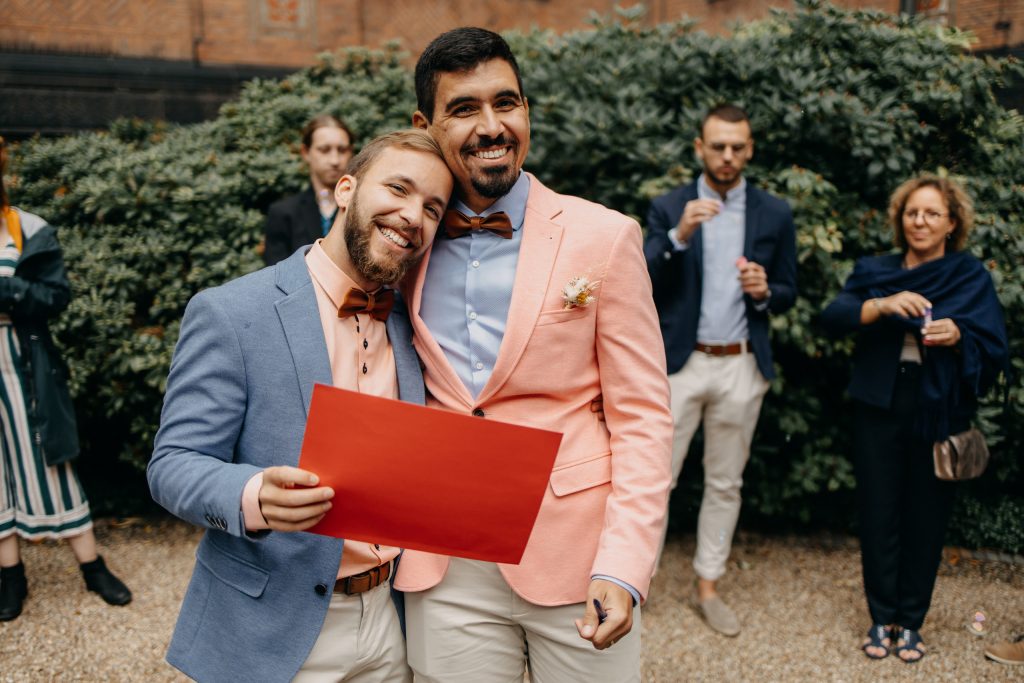
A photographer’s note: the ceremony is over in ten minutes, so we stay close and shoot it as it happens. June light at noon is hard, and the narrow streets and canal shade help. If you want soft light, add an evening walk around 20:30, because sunset in June is close to 22:00. In December the sun sets around 15:40, so take a morning slot. See how it looks in real stories: two grooms in Copenhagen and a wedding at Tivoli Gardens.
 Ronna & Liad · Copenhagen · see the full wedding →
Mistakes that delay approval
- Passport photos without the covers and blank pages, or in poor quality.
- Only one partner completes the form within 14 days.
- Translations missing, not by an authorised translator, or without the apostille stamp translated.
- No marital status certificate from the country where you live now.
- Non-EU partners forget the Entry/Exit System printout and boarding passes.
- A passport, visa or residence permit that expires soon and shortens the certificate.
- Choosing Copenhagen without checking the waiting time against the four months.
the agency is fast with complete files and slow with incomplete ones. One extra evening spent checking every page saves months.
FAQ: getting married in Denmark as a foreigner
Is a Danish marriage valid in my home country?
It is a full legal civil marriage. How your country records it is decided at home. Danish town halls themselves advise couples to check with their local authorities, and many countries ask for an apostille.
How long does it take to get married in Denmark?
Approval can come within 5 working days for a complete application. Add time to collect papers and get a ceremony slot. Two to three months in total is realistic.
Can same-sex couples marry in Denmark?
Yes. All couples marry on equal terms, in the same town halls. Whether your home country recognises the marriage depends on its own law.
Can we marry in Denmark on a tourist visa?
Yes, if you can enter and stay legally. A Schengen visa, a residence permit from a Schengen country or visa-free entry all count, and you must document it in the application.
Can we have a church wedding instead?
It is possible, and the legal check is the same. Each church sets its own conditions, so ask the parish first. Our church versus city hall guide compares the two.
Still choosing a country? Compare the best places to elope in Europe and check where foreigners can legally marry. To plan the hours of the day, use our timeline for the best light.
Planning yours?
We are a team of six photographers and filmmakers with one documentary style, and we have photographed weddings in Copenhagen, including at Tivoli Gardens. Send your date through our contact page and we reply within 24 hours. A 20% deposit reserves the date.
Prices and a calculator are on the investment page. For more on how we work here, see our page for weddings in Denmark.