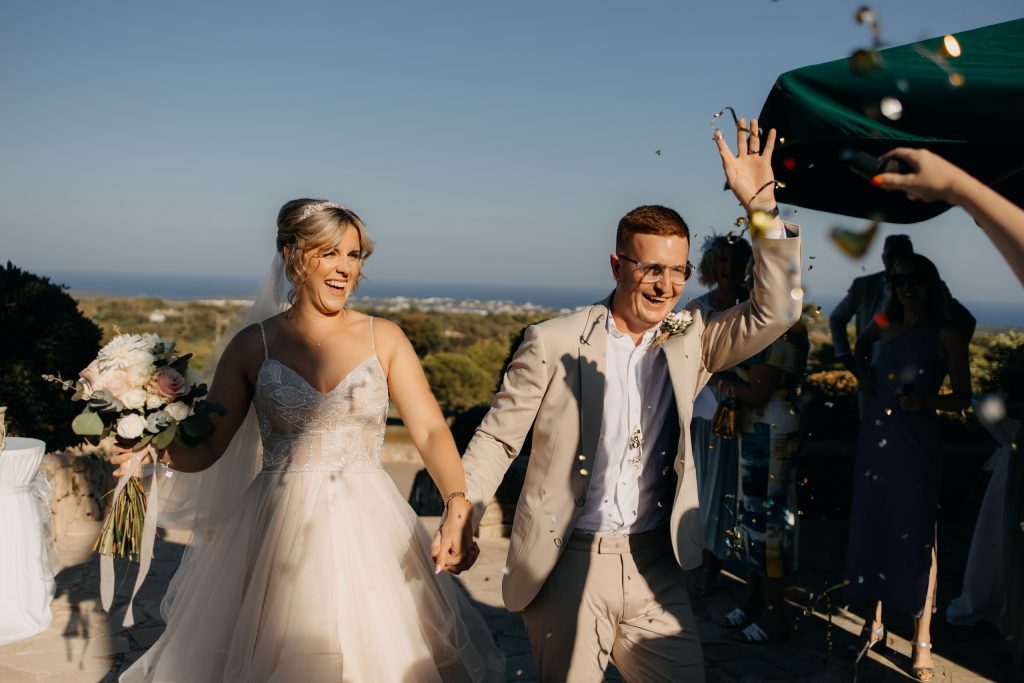
In short: yes, foreigners can marry in Spain, but only if at least one of you is domiciled (officially lives) in Spain, or is Spanish. Spanish law gives the marriage file to the notary, court clerk or civil registry of the place where one of the couple is domiciled, so two visitors who both live abroad have no authority in Spain that can open it. For most visiting couples, the plan is therefore a legal wedding at home and a symbolic ceremony in Spain, on any date and at any venue. Your own embassy and the Spanish authority have the final word on your case.
As of November 2026, these are the rules we confirmed in the law itself and on official pages. Forms change often (the UK forms were updated on 18 June 2026), and several official pages for the US, Ireland and Australia would not load for us. We say where that leaves a gap.
Can foreigners get married in Spain?
Yes, with one condition that decides almost everything. Article 50 of the Spanish Civil Code says that if both partners are foreigners, they may marry in Spain in the form prescribed for Spaniards or in the form of either partner’s national law. The Spanish government’s citizen portal says the same: if both parties are foreigners they can marry in Spain under the same provisions as Spaniards.
The condition is the prior marriage file, the acta or expediente matrimonial that proves you are both free to marry. Every civil wedding in Spain needs one first (Civil Code, Article 56). Who may open it is fixed by law:
- Article 51 of the Civil Code gives it to the court clerk (letrado de la Administración de Justicia), notary or civil registry officer of the place where one of the couple is domiciled, or to the Spanish consul if the couple live abroad.
- Article 58 of the 2011 Civil Registry Law says the same in more detail: the notary of the domicile of either partner, or the court clerk or registry officer of the domicile of one of them.
- A 2005 circular of the Spanish registry authority spells out the result: if neither partner is domiciled in Spain, there is no competent Spanish authority to process the file (BOE circular of 29 July 2005, section VIII).
The UK government’s guidance reaches the same point in plain words: you or your partner must live in Spain or be a Spanish national to marry there.
Can two foreigners get married in Spain if neither lives there?
Not through a registry, notary or court in Spain. In practice, domicile is shown by being registered as a resident of a Spanish town; the planning company Spain4Weddings says registrars typically want about two years of that registration, a business’s experience rather than a rule in the law. The law does name one more door: for couples who live abroad, Article 58 lets the Spanish consulate for the district where they live open the file. We found no official page saying that Spanish consulates do this for two partners who are not Spanish, so ask your nearest Spanish consulate before planning on it.
One commercial page says otherwise. The mallorca.com marriage guide, written for German couples, states that residency is not a mandatory requirement and non-residents can marry at the Registro Civil in Palma. That is that site’s claim, and it does not match the wording of the Civil Code or the Civil Registry Law. If anyone promises you a legal ceremony as two non-resident visitors, ask which authority will open the file and on what basis, and get that in writing before you pay a venue deposit.
the legal route in Spain depends on one of you being domiciled there. If neither of you lives in Spain, marry legally at home and hold the ceremony you want in Spain.
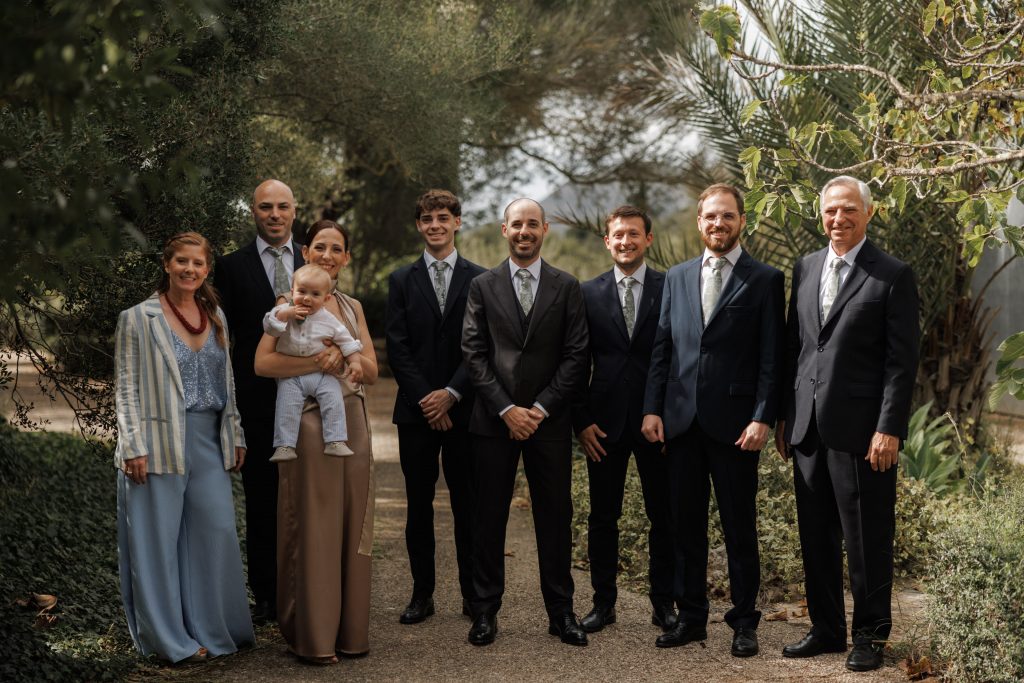 Nacho & Bea · Mallorca · see the full wedding →
Documents by nationality
These matter if one of you is domiciled in Spain. The citizen portal lists what goes with the application: proof of identity, a birth certificate, proof that any earlier marriage has ended, details of two witnesses, and where each of you has lived for the past two years. Foreign documents usually need an apostille (an international stamp that authenticates a document) and a sworn translation into Spanish; the registry or notary tells you exactly which. The table shows the proof of freedom to marry, the document that differs by country.
| You are | Proof of freedom to marry | Source |
|---|---|---|
| British | Apply online for a marital status certificate (MSC) or certificate of no impediment (CNI), with forms signed before a notary in Spain. If you live in the UK, get a CNI from a UK register office first, then exchange it online for one Spanish authorities accept | GOV.UK |
| Canadian | Canada does not issue a certificate of non-impediment. It can issue a statement in lieu, which some countries accept only if issued in Canada | Travel.gc.ca |
| American | Not confirmed by us: the US Embassy’s Spain page would not load. Ask the US Embassy in Madrid and the Spanish authority which statement they accept | Ask the embassy |
| Irish | Not confirmed by us. Ask the Irish Embassy in Madrid and the Spanish authority | Ask the embassy |
| Australian | Not confirmed by us. Ask the Australian Embassy in Madrid and the Spanish authority | Ask the embassy |
Two timing rules come from official pages. The citizen portal says a certificate of marital capacity is valid for six months from its date, so do not collect papers too early. The UK pack page says documents depend on where in Spain you marry and tells couples to contact the civil registry office where you’re planning to get married.
How to get married in Spain as a British, American or Irish citizen
British citizens, or getting married in Spain from the UK
The residence condition applies to you as to everyone: GOV.UK says one of you must live in Spain or be Spanish. If that fits, use the GOV.UK Spain page above. Since 3 February 2025 the UK no longer accepts paper applications for marital status certificates, so you apply online, and each form is signed before a notary in Spain. If neither of you lives in Spain, the UK route is a legal wedding at a UK register office and a symbolic ceremony in Spain. That answers “getting married in Mallorca from the UK” and “getting married in Ibiza from the UK” too.
American citizens (US citizens)
The same Spanish rule applies: one of you must be domiciled in Spain for a file to be opened there. We could not open the US Embassy page, so we do not describe the US document here. Read the embassy page directly and ask the Spanish authority which statement it accepts.
Irish citizens
The same rule again. Ask the Irish Embassy in Madrid which document the Spanish authority will accept as proof that you are free to marry.
Steps in order, if one of you lives in Spain
- Choose who opens the file: a notary where either of you is domiciled, or the court clerk or civil registry where one of you is domiciled (Civil Registry Law, Article 58).
- Ask that office for its document list. Collect passports, birth certificates and proof of freedom to marry, with apostilles and sworn translations as it requires.
- Submit the file. The official hears each of you separately and in private to confirm you are free to marry (Article 58.5), then issues a decision.
- Marry. A file opened by a notary or court clerk lets you choose a notary, court clerk, mayor or councillor; a file opened by the civil registry leads to a ceremony before the mayor or a councillor of your choice (Civil Code, Article 57).
- Sign with two witnesses. The record is sent to the Civil Registry for registration the same day (Article 58.8), and each of you receives a copy.
How long it takes depends on the office. The mallorca.com guide gives its own estimates for the Palma registry: 3 to 6 months to gather documents, 4 to 10 weeks for the review and 2 to 6 weeks to wait after approval. Wezoree, a wedding vendor community, says the registry process can take four to six months. These are businesses’ estimates, not official times; ask your office.
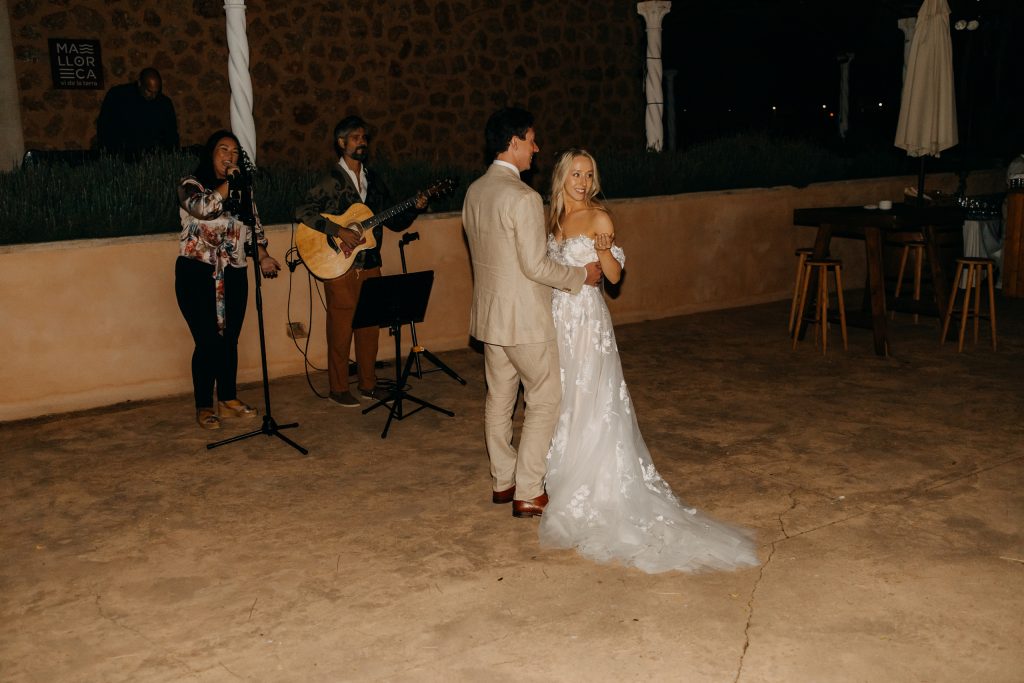 Christopher & Harriet · Mallorca · see the full wedding →
Civil, religious and symbolic weddings in Spain
Civil and religious
Civil: since April 2025 the Civil Code (Article 51) lists the mayor of the town where you marry or a councillor, a court clerk, a notary, or a Spanish consul abroad as the people who may marry you. We found no official fee list for a civil wedding. Notaries and town halls may charge, so ask each for its fee in writing. Religious: Spanish law recognises religious forms of marriage (Civil Code, Article 49), and for faiths recognised as well established in Spain (notorio arraigo) the couple still needs the prior civil file (Civil Registry Law, Article 58 bis). For Catholic weddings, the planning company Spain4Weddings says at least one partner must be Catholic and preparation takes around six months; confirm with the diocese. Our guide City hall vs church weddings in Spain covers the practical side, including curfews and light.
Symbolic wedding in Spain: why most couples choose it
A symbolic wedding has no legal effect, and the mallorca.com guide says so too. For two non-residents it is the route that works. Wezoree says most Ibiza elopement ceremonies are symbolic, and that many international couples marry legally at home and celebrate on the island. The mallorca.com guide prices celebrants from €1,200, citing a 2026 cost guide by an events company.
The routine is simple. You sign at your home town hall or registry, before or after, then hold the ceremony in Spain on any date, at any venue, led by a celebrant or a friend. Our guide Symbolic vs legal wedding ceremony abroad compares the two, and where foreigners can legally marry in Europe shows which countries do not ask for residence.
Can you get married in Mallorca or Ibiza?
Mallorca: yes, under the same national rules. A legal wedding needs one of you to be domiciled in Spain; a symbolic ceremony needs no file at all. The mallorca.com guide says the Registro Civil in Palma covers all municipalities on the island. We have photographed weddings there, for example Christopher and Harriet.
Ibiza: the same national law applies, and Wezoree says most ceremonies there are symbolic. Couples from the UK who live in the UK follow the home-wedding route above.
Same-sex couples
Spain has allowed same-sex civil marriage since 2005, and the citizen portal defines marriage as a union of two persons of the same or opposite sex. The registry authority’s 2005 circular says a same-sex marriage between a Spaniard and a foreigner, or between foreigners residing in Spain, is valid even if the foreigner’s national law does not permit it (BOE circular). The domicile condition applies equally. Recognition at home depends on your own country. Canada’s government notes that same-sex marriages legal in Canada are not recognized in many countries, which matters if you plan to live elsewhere later.
Timeline
| When | What | Note |
|---|---|---|
| 12 to 18 months out | Choose legal or symbolic; check domicile | Neither lives in Spain: plan a home wedding |
| 9 to 12 months | Book venue and photo and film | Good dates go first |
| 6 months | Request documents | Marital capacity certificate valid six months |
| 3 to 6 months | Submit the file (residents) or book the home registry | Ask the office for its timing |
| 1 month | Confirm time and place of the ceremony | Get it in writing |
This is our planning advice, not an official schedule. For the full order of planning, see the destination wedding planning timeline for Europe.
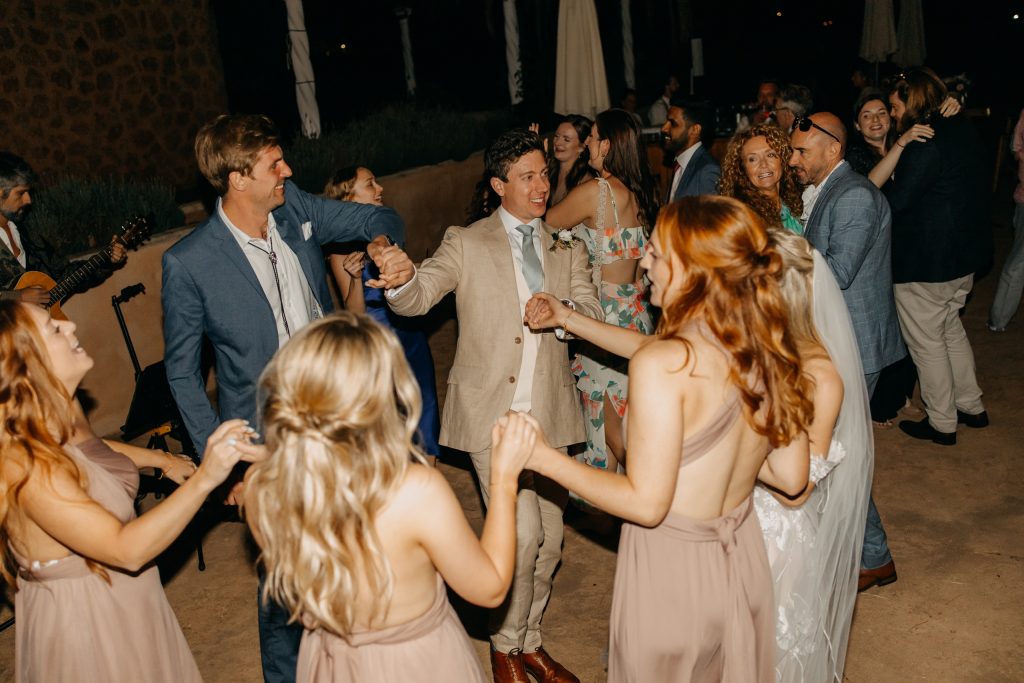 Christopher & Harriet · Mallorca · see the full wedding →
FAQ: getting married in Spain
Can foreigners get married in Spain without a visa?
Marriage rules and entry rules are separate. Whether you need a visa to enter Spain depends on your passport and length of stay, and we cannot give immigration advice: ask the Spanish consulate for your country. For the marriage itself, what matters is domicile, not a visa: one of you must be domiciled in Spain for a file to be opened there.
Can two foreigners get married in Spain?
Yes, if at least one of you is domiciled in Spain (Civil Code, Article 51). If you both live abroad, no Spanish registry, notary or court can open your file; the law mentions the Spanish consulate where you live, so ask it directly.
Can you get married in Spain as a US citizen?
Yes, under the same domicile rule. Confirm the accepted proof of freedom to marry with the US Embassy and the Spanish authority.
Can you get married in Spain as a British citizen?
Yes, if you or your partner live in Spain or are Spanish, as GOV.UK says, following its online MSC and CNI process.
How to get married in Spain as an Irish citizen?
Under the same domicile rule. We could not open the Irish official page, so ask the Irish Embassy in Madrid about documents.
What are the legal requirements for guests?
None that we found beyond two witnesses who sign the record (Civil Registry Law, Article 58.8) and give their identity details. Guests need only the usual travel documents for their passport.
Is a Spanish wedding recognised in my home country?
Usually, yes: Canada’s government says marriages legally performed abroad are usually valid in Canada. Each country sets its own rules, so ask your own authority.
Planning yours?
We photograph and film weddings in Spain as a team of six with one documentary style. See our Spain wedding photographer page. Photography and film packages from €1,390, with no extra travel fees; book any package and change it later, the date is what matters. Check your date (we reply within 24 hours) or see the prices.